


Key Highlights
| Study Period | 2019 – 2032 |
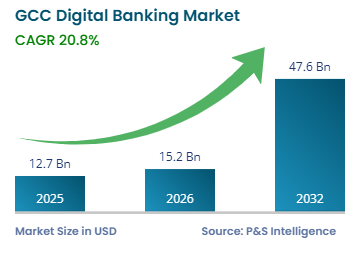
| Market Size in 2025 | USD 12.7 Billion |
| Market Size in 2026 | USD 15.2 Billion |
| Market Size by 2032 | USD 47.6 Billion |
| Projected CAGR | 20.8% |
| Largest Country | Saudi Arabia |
| Fastest-Growing Country | UAE |
| Market Structure | Semi-Consolidated |
Market Size

Explore the market potential with our data-driven report
GCC Digital Banking Market Future Outlook
The GCC digital banking market size will be an estimated USD 12.7 billion for 2025, and it will grow by 20.8% during 2026–2032, to reach USD 47.6 billion by 2032.
The market growth is driven by increasing smartphone penetration, supportive government initiatives aligned with economic diversification strategies, and rising consumer preference for convenient financial services.
The region is experiencing a paradigm shift as governments across the GCC actively promote digital transformation through initiatives such as Saudi Vision 2030 and UAE Vision 2030. According to the SAMA, Saudi Arabia witnessed 70% of retail payments being digital transactions in 2023, with transaction volumes increasing by 24% year on year.
The UAE continues to lead digital banking adoption in the region, with nearly half of banking customers now maintaining accounts with digital banks. Only one in six purchases in the UAE is made in cash. The strong mobile and internet infrastructure, combined with a tech-savvy young demographic, creates a favorable environment for digital banking expansion across all GCC nations.
GCC Digital Banking Market Segmentation Analysis
Component Analysis
The platforms/solutions category holds the largest market share, of 60%, in 2025, due to the critical role that core banking platforms play in enabling comprehensive digital banking operations. Financial institutions across the region are investing heavily in modernizing their technological infrastructure, replacing legacy systems with cloud-native platforms that support omnichannel banking experiences. These platforms provide the foundational architecture for account management, transaction processing, customer relationship management, and regulatory compliance.
The services category will have the highest CAGR, of 21.2%, driven by the increasing demand for professional implementation support, managed services, and ongoing platform optimization. As banks deploy sophisticated digital solutions, they require specialized expertise for system integration, cybersecurity management, data analytics, and regulatory compliance support. The complexity of digital transformation projects necessitates continuous professional services to ensure smooth operations, rapid feature deployment, and alignment with evolving customer expectations.
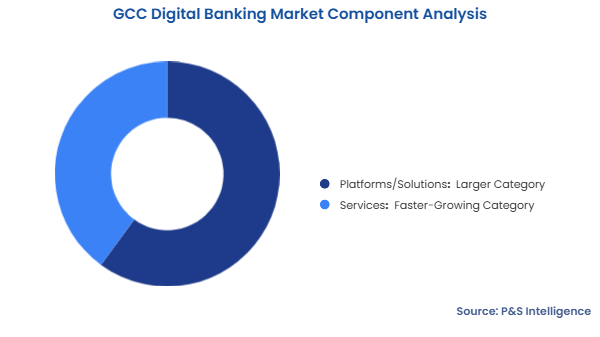

The components analyzed in this report are:
- Platforms/Solutions (Larger Category)
- Services (Faster-Growing Category)
Service Type Analysis
The mobile banking category holds the largest market share, of 55%, in 2025, due to the fundamental shifts in consumer behavior, with users increasingly managing their finances through smartphones rather than desktop computers or physical branches. A 2024 survey found that 81% of Saudi retail banking customers accessed banking services using mobile apps, highlighting the channel’s dominance in the region.
The digital wallets category will have the highest CAGR, of 21.0%, driven by the transition toward cashless societies and the integration of payment capabilities with lifestyle services. The expansion of digital wallet functionality beyond basic payments to include loyalty programs, investment services, and cross-border remittances is attracting substantial user adoption.
The service types analyzed in this report are:
- Mobile Banking (Largest Category)
- Online Banking
- Digital Wallets (Fastest-Growing Category)
- Payment Processing
Type Analysis
The retail banking category holds the largest market share, of 65%, in 2025. It encompasses personal banking services delivered through digital channels, including savings accounts, personal loans, credit cards, and wealth management solutions. The focus on customer experience, personalized offerings, and 24/7 accessibility has driven retail banking’s strong performance in the digital space.
The corporate banking category will have the highest CAGR, of 21.1%, fueled by enterprises’ increasing need for sophisticated cash management solutions, trade finance digitization, and real-time treasury operations. Digital corporate banking platforms enable large organizations to manage complex financial operations across multiple geographies, currencies, and business units through unified interfaces. The integration of AI-driven analytics, automated reconciliation, and predictive cash flow forecasting adds significant value for corporate clients.
The types analyzed in this report are:
- Retail (Largest Category)
- Corporate (Fastest-Growing Category)
- Investment
Deployment Type Analysis
The cloud category holds the larger market share, of 50%, in 2025, and it will have the higher CAGR during the forecast period. This is because it offers financial institutions scalability, flexibility, and cost-effectiveness compared to traditional on-premises systems. Banks can rapidly deploy new features, scale resources based on demand, and reduce capital expenditure on physical infrastructure. Cloud platforms also facilitate faster disaster recovery, enhanced collaboration, and easier integration with third-party fintech services.
The deployment types analyzed in this report are:
- Cloud-Based (Larger and Faster-Growing Category)
- On-Premises
End User Analysis
The banking and financial institutions category holds the largest market share, of 70%, in 2025, because these institutions are the primary adopters of digital banking platforms and services, handling the majority of transactions, deposits, and financial operations across the GCC region. Traditional banks, Islamic banks, and specialized financial institutions are the primary adopters of digital banking platforms, using these solutions to modernize operations, reduce costs, and compete effectively with digital-native challengers. Established banks leverage digital platforms to offer omnichannel experiences, while maintaining their extensive customer relationships and regulatory compliance capabilities.
The fintech companies category will have the highest CAGR during the forecast period, as these technology-first organizations continue disrupting traditional banking models with innovative solutions. Fintech firms specialize in niche offerings such as peer-to-peer lending, robo-advisory services, digital remittances, and embedded finance solutions. Their agile development processes and customer-centric approaches enable rapid iteration and market responsiveness.
The end users analyzed in this report are:
- Banking and Financial Institutions (Largest Category)
- FinTech Companies (Fastest-Growing Category)
- Insurance Providers
- E-commerce and Retail
- Government and Public Sector Entities
Drive strategic growth with comprehensive market analysis
GCC Digital Banking Market Regional Outlook
UAE Digital Banking Market Size
UAE holds the largest market share, of 40%, in 2025, reflecting the country’s advanced technological infrastructure, progressive regulatory environment, and highly digital-savvy population. The UAE government’s commitment to becoming a leading digital economy has accelerated the adoption of cashless payments, mobile banking, and fintech innovation across the emirates.
The country hosts the region’s largest concentration of digital banks, with nine digital challengers operating across various segments. Major financial institutions, including Emirates NBD, Mashreq, and Commercial Bank of Dubai, have implemented comprehensive digital transformation strategies, while neobanks such as Wio, Zand, Liv, and YAP have gained substantial market traction.
A 2022 study found that 19% of the consumers in the UAE have a digital bank account, with an additional 15% intending to open one within a year. The UAE benefits from exceptional mobile and internet penetration rates, sophisticated payment infrastructure, including the Aani instant payments platform, and free zones that attract fintech investment. Dubai’s ambition to process 90% of the transactions cashlessly by 2026 further accelerates digital banking adoption across consumer and business segments.
Saudi Arabia Digital Banking Market Size
Saudi Arabia will have the highest CAGR of 20.9%, as the kingdom’s rapid digital banking expansion aligns with Saudi Vision 2030 objectives to diversify the economy and promote technological innovation. The subsequent launches of Vision Bank and STC Bank in January 2025 have intensified competition and expanded digital banking access across the kingdom. SAMA’s proactive regulatory approach, including the expansion of its fintech sandbox, has created an environment conducive to innovation while maintaining financial stability.
STC Pay boasts over 8 million users as of 2024. Saudi Arabia’s substantial infrastructure investments, growing e-commerce sector, and increasing smartphone penetration create favorable conditions for sustained digital banking growth across retail and corporate segments.
The countries of the market are as follows:
- Saudi Arabia (Fastest-Growing Country)
- UAE (Largest Country)
- Qatar
- Bahrain
- Kuwait
- Oman
GCC Digital Banking Market Share
The market is semi-consolidated, reflecting the coexistence of established banking institutions undergoing digital transformation alongside emerging digital-native challengers and fintech specialists. The competitive landscape features intense rivalry as traditional banks invest billions in technology upgrades while neobanks leverage their cost advantages and agile operating models. Major regional banks, including Emirates NBD, Saudi National Bank, Al Rajhi Bank, and Qatar Islamic Bank, have established significant digital banking capabilities through sustained technology investments and strategic partnerships. Simultaneously, digital-only banks such as Wio, Zand, D360, and STC Bank have captured market attention. Collaboration between banks and fintech companies has blurred traditional boundaries and intensified competition.
Key GCC Digital Banking Companies:
- Emirates NBD PJSC
- Mashreqbank PSC
- STC Bank
- D360 Bank
- Alinma Bank
- Zand Bank
- Liv. by Emirates NBD
- Meem by Gulf International Bank
- N26 Middle East
- YAP
- Bank ABC Digital
- Wio Bank PJSC
link