


To print this article, all you need is to be registered or login on Mondaq.com.
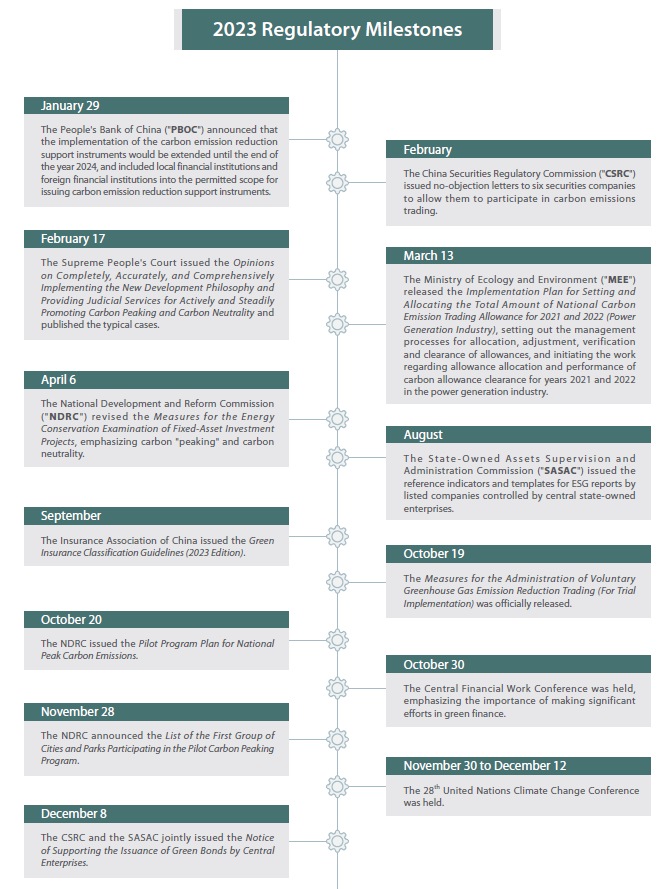

2023 REGULATORY MAINLINE REVIEW
1. Significant regulatory breakthroughs in peak carbon and
carbon neutrality; interplay of legislative initiatives and changes
respond to market needs
In 2023, a number of regulations, documents or consultation
drafts in relation to climate change and “Carbon Peaking and
Carbon Neutrality” were introduced to provide legislative
support for sustainable development. The measures taken were:
- firstly, the legislative hierarchy has been improved. After
continuous refinement of the draft in 2023, the Interim
Regulation on the Administration of Carbon Emission Trading
was formally adopted at the executive meeting of the State Council
on January 5, 2024. This is the first domestic administrative
regulation for administration of carbon emission trading and
addresses the issues that had arisen from existing regulations and
rules for carbon emissions trading (i.e. the goals of regulating
trading activities, guaranteeing trading data quality and punishing
illegal behaviors were only somewhat erratically supervised by the
relatively low-level (i.e. not central level) legislative hierarchy
of such existing regulations and rules). - secondly, on October 19, 2023, the long-awaited Measures
for the Administration of Voluntary Greenhouse Gas Emission
Reduction Trading (For Trial Implementation) (the
“New CCER Regulation“) was officially
released, as the basis and guideline for the systems of the
restarted national greenhouse gas voluntary emissions reduction
trading market (the “CCER Market“). - thirdly, in April 2023, the NDRC revised the Measures for
the Energy Conservation Examination of Fixed-Asset Investment
Projects, emphasizing the integration of energy conservation
with the goal of “Carbon Peaking and Carbon Neutrality”;
on March 16, 2023, the NDRC issued a consultation draft of the
revised Guiding Catalog of Green Industries, which is
expected to be formally promulgated and implemented in 2024;
moreover, the NDRC issued a revised version of the Catalogue
for Guiding Industry Restructuring at the end of 2023, which
became effective on February 1, 2024 and emphasized the energy
saving, carbon emission reduction and green transition.
The promulgation or update of the foregoing regulations and
documents not only responds to the development and practice of the
goal of “Carbon Peaking and Carbon Neutrality”, but also
provides strong support for achievement of such goal.
According to the legislative plan released by the Standing
Committee of the 14th National People’s Congress in September
2023, the legislation with aims of addressing climate change and
achieving Carbon Peaking and Carbon Neutrality is still considered
as a legislative project which lacks certain legislative conditions
and requires further research. Therefore, the enactment of laws to
be promulgated by the National People’s Congress such as
Climate Change Law, Carbon Emission Reduction Law or
Carbon Financial Inclusion Law may take more time; while
the revisions to be made on some other laws such as the Energy
Law, the Renewable Energy Law, and the Marine
Environmental Protection Law have been put on the agenda, with
the expectation of incorporating the applicable contents to address
climate change and ensure the realization of the goal of
“Carbon Peaking and Carbon Neutrality”.
2. “1+N” Policy Framework Upgraded; Transition
Finance and Inclusive Carbon Financeng
The policies and guidelines issued by applicable authorities and
central and local governments remain as the important tools for
addressing climate change and achieving the goal of “Carbon
Peaking and Carbon Neutrality”.
In 2023, under the established “1+N” policy framework
for Carbon Peaking and Carbon Neutrality, the supporting policies
were further refined by the appropriate regulatory authorities
:
- following the promulgation of provincial-level implementation
plans for Carbon Peaking in many provinces in 2022, some
sector-specific Carbon Peaking implementation plans were further
introduced in 2023 in some provinces/municipalities (e.g. those
issued in Hebei, Inner Mongolia, Zhejiang, Fujian, Chongqing,
Tibet, Shaanxi and Qinghai, and the Carbon Peaking implementation
plans for the urban-and-rural construction sector issued in Hebei,
Shanxi, Jiangsu, Fujian, Shandong, Henan, Hubei, Hunan, Chongqing,
Guizhou, Qinghai and Xinjiang); - at the end of October, the NDRC issued the Pilot Program
Plan for National Peak Carbon Emissions, proposing that
“financial institutions shall be encouraged to support the
construction of cities and industrial parks implementing the peak
carbon dioxide emissions pilot program, comprehensively use
financial tools such as green credit, green bonds and green funds,
and increase support for relevant green and low-carbon projects in
a market-oriented manner”, and also announced the list of
first group of national “carbon peaking” pilots at the
end of November; - on December 8, the CSRC and the SASAC jointly issued the
Notice of Supporting the Issuance of Green Bonds by Central
Enterprises, guiding and supporting the central enterprises to
raise funds through the green bonds market, and boosting the
development of the green industry.
Climate finance is an important policy instrument in achieving
the goal of “Carbon Peaking and Carbon Neutrality”. After
the jointly announced list of climate finance pilots (i.e. a total
of 23 approved pilot cities/areas) by MEE and eight other
applicable authorities in August 2022, these pilot cities/areas
have issued a series of policies to promote the implementation of
the pilot programs, the majority of which have already established
the climate finance project databases and platforms to match
governments, banks and enterprises in 2023. Certain pilots such as
Nansha District in Guangzhou, have put in place specific and
quantitative financial incentive policies for enterprises, projects
and talented persons.
In addition to climate finance, the promulgation of G20
Transition Finance Framework issued in the end of 2022, which
was led by the PBOC (as one of the co-chairs of the G20 Sustainable
Finance Working Group), marks the first international consensus
reached between major countries on the development of transition
finance. In March 2023, the government work report of the 14th
National People’s Congress emphasized the importance of the
role of finance in bringing about green transition. At the end of
March, the vice-governor of the PBOC was also quoted as saying that
the PBOC would actively promote the promulgation and implementation
of transition finance standards as soon as practicable. The PBOC
has taken the lead in drafting transition finance standards for
four industries (i.e. the industries of coal and electricity, iron
and steel, building materials and agriculture) and would publish
consultation drafts in due course. The finance work plans and green
finance policies by local regulatory authorities also mentioned the
promotion of the linkage between green finance and transition
finance. As for the market practice, the Bank of China issued the
first steel transition finance bond (the first in the world) on
October 12 with all the funds raised being used to support the
green transition projects of the iron and steel industry in Hebei
province.
In 2023, the local governments actively explored policies of
carbon financial inclusion. For example:
- the Key Tasks List for the 2023 Municipal Government Work
Report of Beijing proposed improving incentives for carbon
financial inclusion and incorporating low-carbon travel scenarios
such as replacing fuel-powered motor vehicles with electric ones
into the scope of carbon financial inclusion incentives; - several work plans (or drafts) to create a carbon financial
inclusion system were published in some provinces, such as Shandong
and Anhui, proposing the establishment of personal carbon accounts
and offset channels for certified emission reduction of carbon
financial inclusion, the formation of expert committees for carbon
financial inclusion, and the development of appropriate
institutional standards and methodologies; - the authorities in Hainan and Guangzhou issued
implementation/administration measures on carbon financial
inclusion; - the Cooperation Framework Agreement for the Construction of
the Carbon Financial Inclusion Platform in the Greater Bay
Area was entered into by two organizations in Guangdong
Province and the Macau Special Administrative Region, aiming to
cooperate in the exploration of carbon financial inclusion; - the Shanghai Municipal Bureau of Ecology and Environment issued
the Administration Measures for Carbon Financial Inclusion in
Shanghai Municipality (for Trial Implementation) in November,
and also published a series of ancillary guidelines such as the
development and application guidelines for methodologies, and
carbon financial inclusion projects and carbon emission reduction
scenarios, as well as the guidelines on the use of carbon financial
inclusion credits. These efforts have laid the foundation for
establishing a local carbon financial inclusion system.
3. New Green Finance Policies Open Up to New Participants and
Products
In 2023, more regulations and policies related to green finance
were implemented:
- with the expiration of the one-year transition period in May
2023 as provided in the Guidelines on Green Finance for the
Banking Industry and the Insurance Industry, the banking and
insurance institutions have set up and refined their internal green
finance-related management systems and processes; - in September, the Insurance Association of China issued the
Green Insurance Classification Guidelines (2023 Edition),
which provides self-regulation in three aspects: green insurance
products; green investment of insurance funds; and green operation
of insurance companies; - The central and local regulators issued policies to encourage
and support the local development of green finance and carbon
finance. For example, (i) the former CBIRC, the CSRC and the State
Administration of Foreign Exchange (“SAFE”) and some
other authorities, together with the Guangdong Province Government,
jointly issued the policy to support the development of green
finance in Guangdong-Macao In-Depth Cooperation Zone in Hengqin and
Qianhai Shenzhen-Hong Kong Modern Service Industry Cooperation Zone
and strengthen the green finance cooperation in the GBA; (ii) the
financial regulators in a number of provinces/municipalities such
as Shanghai, Beijing, Tianjin, and Hebei introduced policies to
actively promote the healthy development of the local green finance
market; and (iii) the Shandong Province Government launched a
three-year action plan to promote the development of carbon
finance.
It is expected that the green finance related regulations will
be further revised and refined under the existing institutional
framework in the coming period.
With the ongoing development of the domestic sustainable finance
market, the policies have become increasingly open to attract
various types of market participants to participate in sustainable
finance. For example, at the end of January 2023, the PBOC not only
decided to extend the effective period for the implementation of
the carbon emission reduction support instruments to the end of
2024, but also extended the scope of institutions permitted to
issue such instruments to include local financial institutions and
foreign financial institutions, as well as national financial
institutions, aiming at encouraging more financial institutions to
participate in the financing of such areas as clean energy, energy
conservation and environmental protection, and carbon emission
reduction technologies by using monetary policy tools.
In terms of the carbon market, in February 2023, six securities
company announced that they had received no-objection letters from
the CSRC to allow them to participate on their own account in
carbon emissions trading. To date, eight securities company have
successfully obtained such official no-objection letters and are
permitted to carry out proprietary trading in the carbon emissions
trading market.
While the market for single green-themed financial products has
become more mature, there is more activity when it comes to
exploring new products which combine greenness with something else.
For example, the first domestic green and energy supply dual-themed
asset-backed security (“ABS”) was issued in April 2023,
followed by the issuance of the first domestic green and low-carbon
transition-linked ABS in June. Green financial products have also
been developed to cover sectors such as rural revitalization: for
example, in March, the Agricultural Bank of China took the lead in
underwriting the first domestic carbon emission right asset-backed
bond with four themes (i.e. carbon neutrality, carbon assets, rural
revitalization and old revolutionary base areas). Currently,
innovations in the green finance market are still mainly about
investments, i.e., incorporating green investment targets and
sustainable elements such as green and/or low-carbon performance
indicators into more traditional and mature transaction and product
structures. We expect that innovations in product structures will
gradually emerge as the market deepens its understanding of green
finance in the future.
4. Carbon Quotas: Stable Nationwide Market with Continued
Regional Growth
In terms of the “top-level” legal framework, the
Interim Regulation on the Administration of Carbon Emission
Trading (“Interim Regulation“) was
formally adopted at the executive meeting of the State Council on
January 5, 2024, laying out the basis of the institutional
framework for administration of the carbon emission trading in the
mandatory National Carbon Market. The Interim Regulation clarified
the trading system of the national carbon market for the first time
in the form of the administrative regulation. This addresses
defects in the existing regulations and rules (such as the
Measures for the Administration of Carbon Emissions Trading
(for Trial Implementation)) but also coordinates the efforts
of multiple applicable authorities (including ecological and
environmental departments) to promote the development of the
trading and management of carbon emissions trading. Another
highlight of the Interim Regulation is that compared with the
existing regulations, it strengthens the processes for punishing
those acting illegally (such as falsifying carbon emission data) in
order to safeguard quality of carbon emission data.
The second performance period of the national carbon emissions
trading market (the “National Carbon
Market“) has finished. On July 17, the General Office
of the MEE issued the Notice on the Work Related to the
Clearance of Carbon Emission Allowances for the Years 2021 and 2022
in the National Carbon Market, according to which the second
performance period of the National Carbon Market was two years
(i.e. the relevant key emission entities were required to complete
the settlement and clearance of carbon emission allowance allocated
respectively for the years of 2021 and 2022 before December 31,
2023). The policies for the second performance period will
introduce differentiated allowance allocation and performance and
also introduces flexibility when it comes to allocations of carbon
emission allowances, to make adjustments for those with allocation
shortfalls or facing clearance difficulties.
Regional carbon markets continued to play a role in 2023. Some
regional carbon markets have made significant adjustments, for
example lowering the entry threshold for market participants,
expanding the scope of industries affected and introducing
innovative products. The current version of the Interim Regulation
does not require existing regional carbon markets to be
incorporated into the National Carbon Market. These regional carbon
markets must be aligned with the Interim Regulation. Although
regional carbon markets will gradually be phased out as the
national carbon market takes over, they can still serve as useful
policy testing grounds.
5. Voluntary Carbon Market: CCER Market Relaunched with
Regulatory Framework Beginning to Take Shape
The voluntary greenhouse gas emission reduction trading market
(“CCER Market“) and the National Carbon
Market complement each other. Together, they are the two basic
pillars of the carbon market in China. On October 19, 2023, the
long-awaited New CCER Regulation was formally released, serving as
the foundation and guidance for the regulatory framework of the
relaunched CCER Market. Based on that, the applicable regulatory
authorities issued ancillary rules (such as the four methodologies
for CCER projects in the categories of forestation carbon sinks,
mangrove vegetation, grid-connected solar thermal power generation,
and grid-connected offshore wind power generation; the guidelines
for the design and implementation of CCER projects; the
registration and trading settlement rules for CCER projects; and
the implementation rules of approval and carbon emission reduction
verification of CCER projects). All of this means that the
preliminary regulatory framework of the national CCER Market has
been set up.
Benefiting from the relaunch of the CCER Market, loan products
linked to the registration or development progress of CCER projects
have emerged. The Industrial Bank issued the first loan product
linked to approval and verification of CCER projects. So far as the
carbon sink market is concerned, the CPC Central Committee and the
State Council proposed the inclusion of certified voluntary
emission reductions from carbon sinks in relation to conservation
of water and soil and forest resources in the voluntary carbon
market in the Opinions on Strengthening the Water and Soil
Conservation Work in the New Era and the Reform Program on
Deepening the Collective Forest Right System. This points to
the integration of the carbon sink market and carbon market.
6. Towards a Standardized System for Carbon Reduction; Carbon
Footprint Regulatory Framework Taking Shape
In April 2023, the Standardization Administration and other 10
departments jointly issued the Guideline for Establishing a
System of Standards for Carbon Peaking and Carbon Neutrality,
which sets out a series of standardization construction work and
objectives related to “Carbon Peaking and Carbon
Neutrality” (including green finance product and service
standards and green finance evaluation and assessment standards).
In July, the National Technical Committee of Carbon Peaking and
Carbon Neutrality Measurement and its technical sub-committees were
set up, and one of their core tasks is to strengthen the
requirements for measuring data on carbon emissions and carbon
monitoring, and to research and formulate technical specifications.
The objective is to ensure robust measurement of carbon trading and
carbon verification. Standards for environmental assessment, carbon
emissions and energy consumption for various industries are
gradually being formulated and released.
In 2023, the applicable authorities outlined the framework for
how the carbon footprint in China is managed. On October 12, 2023,
the State Administration for Market Regulation issued the
Implementation Opinions of the State Administration for Market
Regulation on Coordinating the Use of Quality Certification to
Serve the Work of Achieving Carbon Dioxide Peaking and Carbon
Neutrality, which requires that carbon identification
certification (such as the product carbon footprints) to be carried
out gradually. On October 20, the NDRC issued the Pilot Program
Plan for National Peak Carbon Emissions, proposing to explore
the ancillary policies such as product carbon footprint management.
On November 13, the NDRC and other four departments jointly issued
the document guiding the establishment of the domestic product
carbon footprint management system, (Opinions on Accelerating
the Establishment of a Product Carbon Footprint Management
System). The document clarifies the overall requirements, key
tasks, safeguard measures and organizational implementation
requirements for enhancing the management level of key product
carbon footprint in China, builds up the overall framework of the
product carbon footprint management system, and expressly supports
enterprises to voluntarily carry out product carbon footprint
certification, as required by the market. In terms of general
standards, in November 2023, the applicable departments issued the
consultation draft of the recommended national standard of
Requirements and Guidelines for Quantification on the
Greenhouse Gases Carbon Footprint of Products. In addition,
the China National Accreditation Service for Conformity Assessment
issued the consultation draft of the Accreditation Scheme for
Product Carbon Footprint Validation and Verification Bodies on
January 4, 2024.
7. ESG Disclosure Brought in Line with International
Standards
In recent years, although China’s companies have made
progress in their ESG development and the scope and quality of ESG
disclosure, the lack of unified, standardized and localized rules
has long been a pain point hindering their development of ESG. In
response to the requirements of the Work Plan for Improving the
Quality of Listed Companies Controlled by Central SOEs issued
by the SASAC of the State Council in 2022, the General Office of
the SASAC issued the Notice on Research on the Preparation of
ESG Special Reports of Listed Companies Controlled by Central
SOEs in August 2023, in order to facilitate the preparation of
ESG special reports by listed companies controlled by central
state-owned enterprises (SOEs). This is the first time that the
Chinese government has provided specific and systematic
interpretations of ESG disclosure standards. The appendix includes
the Reference Indicator System for ESG Special Reports of
Listed Companies Controlled by Central SOEs and the
Reference Template for ESG Special Reports of Listed Companies
Controlled by Central SOEs, which provide basic references for
state-owned listed companies in the preparation of ESG special
reports. The selected ESG indicators align with the international
common standards such as GRI, TCFD, SDGs (United Nations
Sustainable Development Goals) and ISO, and are conceptually
consistent with the new ISSB standards.
In terms of industries, the Insurance Association of China
issued the Guideline on Disclosure of Environmental, Social and
Governance (ESG) Information for Insurance Institutions on
December 13, 2023. The guideline is the first domestic industrial
self-regulatory document focusing on the framework and content of
ESG disclosure in the insurance sector, which combines China’s
particular circumstances with international advanced practice, with
special emphasis on disclosure requirements related to rural
revitalization and financial inclusion. The Beijing Private Equity
Association released the General Principles for Disclosure of
Sustainable Investment Information for Private Investment Fund
Managers on September 4, 2023, which became the world’s
first group standard in the private investment fund sector in terms
of sustainable investment/ESG.
8. Judicial Practice In Step with the Times
As the goal of “Carbon Peaking and Carbon Neutrality”
continues to advance, the judicial practice in China related to
green finance and the carbon market is also keeping up. In February
2023, the Supreme People’s Court issued the Opinions on
Completely, Accurately, and Comprehensively Implementing the New
Development Philosophy and Providing Judicial Services for Actively
and Steadily Promoting Carbon Peaking and Carbon Neutrality.
This document requires China’s judicial systems to
“adjudicate the cases related to energy conservation and
emission reduction, low-carbon technologies, carbon trading, green
finance and other related matters in accordance with the law; to
promote climate change mitigation and adaptation”, emphasizes
the “establishment and improvement of the trial mechanism for
carbon-related cases”, and puts forward specific opinions on
the trial methods and key points of the 17 types of cases closely
related to the goal of “Carbon Peaking and Carbon
Neutrality” (such as the cases relating to economic and social
green transition, industrial restructuring, low-carbon energy
system construction, and carbon market trading). On the same day,
the Supreme People’s Court also released new types of cases in
relation to environmental resource trials in recent years,
involving (among others) environmental infringement cases arising
from greenhouse gas emissions, disputes over carbon emission
allowances transfer contracts, disputes over CCER technical service
contracts, enforcement of administrative penalties for the
settlement of carbon emission allowances, and enforcement of carbon
emission allowances. Such cases reflect the active exploration and
practice of the judicial system on the protection of new types of
environmental rights and interests, and will provide important
reference for the subsequent relevant cases across the country.
In terms of the criminal cases, the Interpretation of
Several Issues Concerning the Application of Law in Handling
Criminal Cases Involving Environmental Pollution issued by the
Supreme People’s Court and the Supreme People’s
Procuratorate on August 8, 2023, mentioned the issue of criminal
liability for the authenticity of information related to carbon
emissions, and stated that “where any employee of an
intermediary organization charged with the duty of inspection and
testing of greenhouse gas emissions, or preparation or inspection
of emission reports intentionally provides a false supporting
document” may be liable for the crime of providing false
supporting documents.
So far as enforcement goes, in September 2023, China’s first
judicial case connected with CCER was completed in Sichuan
province. The case marked the first attempt to extend the judicial
enforcement of carbon assets to voluntary carbon emission
reduction, based on the previous enforcement cases related to
carbon emission allowances. The effectiveness of pledging carbon
assets such as carbon emission allowances and CCER has long been a
major concern preventing financial institutions from participating
in carbon financial transactions and developing related products.
Although the reasons for the enforcement of the abovementioned CCER
were not disclosed publicly, this case not only provides useful
experience for the enforcement of carbon assets in the future, but
also boosts market confidence in the liquidity and enforceability
of CCER in the context of the relaunch of the CCER market. It
should also provide a judicial basis for the further development of
the financial business of carbon asset pledge by Chinese financial
institutions in the future.
2024 REGULATORY OUTLOOK
1. With the Regulatory Framework in Place, Detailed Regulations
Will Follow
The promulgation of the Interim Regulation fills the gap in the
high-level legislation on carbon emission trading. We expect that
the applicable authorities will engage in the formulation and
updates of applicable ancillary regulations, measures, standards
and other specific rules (e.g., the coordination process between
the authorities, mechanisms for integrating with the green power
system, the rules related to data quality, the formulation of lists
of key emission entities in specific industries, the allocation and
settlement of carbon emission allowances, the rules for statistical
accounting of greenhouse gas emission data, and the rules for
submission and verification of annual emission reports, and so on),
and further consolidate the institutional framework content of
carbon market under the regulatory framework of the Interim
Regulation .
Although local regulatory authorities are actively exploring
carbon financial inclusion policies, currently no national-level
policy for carbon financial inclusion exists. On August 31, 2023,
the MEE published its Reply to Proposal No. 5859 of the First
Session of the 14th National People’s Congress, to which,
regarding the proposal to formulate the Carbon Financial Inclusion
Promotion Law (Draft) and set up the pilots of carbon financial
inclusion, the MEE replied that “it would collaborate with the
other relevant authorities to conduct researches on the
standardized construction, operation and management of carbon
financial inclusion system, in conjunction with the construction of
the greenhouse gas voluntary emission reduction trading market, and
provide useful guidance for the healthy development of local carbon
financial inclusion systems”.
With respect to the establishment of ancillary rules and
standards of carbon financial inclusion, the MEE said that it would
apply the international standard ISO 14067:2018 (i.e.
Greenhouse gases — Carbon footprint of products —
Requirements and guidelines for quantification) as the common
basic standard, and would work with relevant authorities to improve
the measurement and standard systems for “Carbon Peaking and
Carbon Neutrality”, and conduct in-depth studies about the
unified carbon financial inclusion platform and the necessity and
feasibility of setting up a national carbon financial inclusion
management and operation institution. In the Opinions of the
CPC Central Committee and the State Council on Comprehensively
Promoting the Construction of Beautiful China issued on
January 11, 2024, there is explicit mention for the first time of
“the exploration of establishing of public participation
mechanisms such as Carbon Financial Inclusion” in such a
central level policy. We therefore expect that the top regulatory
framework on carbon financial inclusion will be introduced at some
point.
2. Expansion of the National Carbon Market and Regulatory
Innovation On Course
Although the current National Carbon Market only covers the
power generation industry, we fully expect the industry coverage of
the National Carbon Market to expand. The regulatory authorities
have made this clear through frequent announcements. On October 27,
2023, Xia Yingxian, the head of the Department of Climate Change of
the MEE, mentioned in a press conference that the next step is to
include more eligible industries into the National Carbon Market.
The MEE carries out annual verification of annual carbon emission
accounting reports for industries such as petrochemicals,
chemicals, building materials, iron and steel, non-ferrous metals,
paper-making, civil aviation and other industries and will
prioritize the inclusion of industries that contribute
significantly to achieving the goal of “Carbon Peaking and
Carbon Neutrality”, have overcapacity, exhibit significant
potential for pollution reduction and carbon reduction synergy, and
have good data quality foundations. In November 2023, Zhao Yingmin,
the vice-minister of the MEE, also publicly stated the intention to
“actively and prudently” include more high-carbon
industries in the National Carbon Market.
Also noteworthy is the approach being taken which involves
enterprises bidding for carbon emission allowances. Since 2015,
pilot regional carbon markets have been trying to organize paid
bidding for carbon emission allowances. The regulatory provisions
on paid allocation of carbon emission allowances have evolved from
the previous provision of “paid allocation may be introduced
in due time” as set out in the Measures for the
Administration of Carbon Emissions Trading (for Trial
Implementation) to the current provision of “a method
combining free with paid allocation will be gradually
promoted” as provided in the Interim Regulation. In December
2023, a seminar on paid allocation of carbon emission allocation in
carbon market was held in Beijing, in which more than 30 experts
from the MEE’s Department of Climate Change, universities and
research institutes, exchanges, certification agencies, and
industries (such as power generation, iron and steel,
petrochemicals, building materials, and nonferrous metals)
discussed the necessity, urgency and feasibility of paid allocation
of carbon emission allowances, design of paid allocation schemes,
and the raising and use of paid allocation revenues, among other
topics. This may lead to the development of a paid allocation
scheme for carbon emission allowances in the National Carbon Market
in the near future.
3. Carbon Markets to Gradually Link Up with Other Green Energy
Regimes and Policy Tools
With the development of the carbon market, the connection
between the carbon market and other green resource framework and
policy tools is gradually happening. In September 2023, the Central
Committee of the Communist Party of China and the State Council
issued the Reform Program on Deepening the Collective Forest
Right System, which emphasizes the connection between the
reform of China’s collective forest rights and the green
finance and the carbon market. The document not only proposes
giving full play to the leading role of green finance, studying the
inclusion of eligible forest rights trading services and deep
processing of forest products into the scope of green finance, and
increasing financial support, but also mentions the possibilities
of forestry carbon credit, supporting qualified forestry carbon
sink projects to be developed into greenhouse gas voluntary
emission reduction projects and to participate in market trading,
and the creation of an ecological protection compensation system
reflecting the value of carbon sinks. Although forestry carbon
credits have not yet been included in the trading products of the
National Carbon Market or include allowance for offset by key
emission entities, we will watch out for integration of forestry
carbon credits with green finance, carbon financial products and
market mechanisms before too long.
The connection between the green power market, the carbon market
and the green finance market is also worth watching. In early
December 2023, Hubei Province took the lead in trying out a trading
scheme that links the electricity, carbon and finance markets. In
this scheme, enterprises can obtain low-interest green loans by
pledging carbon emission allowances and using the funds to purchase
green electricity, which in turn can be used to offset a certain
amount of carbon emission allowances. In 2023, policies and
programs for the connection between green electricity and the
carbon market were issued in Beijing, Tianjin and Shanghai.
Although these policies are currently only piloted in certain
enterprises with limited coverage, they serve as a good
demonstration of how the electricity and carbon markets can work
together.
4. Unified ESG Disclosure Standards to Spur Regulation of ESG
Rating Agencies
Although the establishment of unified ESG disclosure standards
has been a long-standing topic, the release of the Reference
Indicator System for ESG Special Reports of Listed Companies
Controlled by Central SOEs and the Reference Template for
ESG Special Reports of Listed Companies Controlled by Central
SOEs by the General Office of the SASAC signifies a solid
first step taken by top-level regulators towards applicable unified
ESG disclosure standards for enterprises in different industries
and sectors. Although these documents still only apply in scope to
state-owned enterprises, with the accumulation of practical
experience and feedback, it is certain that the authorities will
further introduce ESG disclosure standards with a broader scope of
application.
In addition to the lack of unified actions and disclosure
standards, the inconsistency and lack of transparency in the
evaluation standards of ESG rating agencies is also one of the
reasons that makes it difficult for enterprises to engage in ESG
development. Some other jurisdictions have already explored the
regulation of ESG rating agencies in 2023. For example, the HM
Treasury in the UK has launched a consultation on regulations to
bring all ESG-related data and rating products (regardless of
whether they are identified as ESG ratings) under the oversight of
the Financial Conduct Authority (“FCA“);
the European Commission has also followed suit by proposing
regulation rules for ESG rating agencies that are roughly
consistent with the EU’s Benchmarks Regulation
(“BMR“) system; and the Monetary
Authority of Singapore (“MAS“) released
an official version of Code of Conduct for ESG Ratings and Data
Product Providers on December 7 and encourages ESG rating
agencies to disclose how much their voluntary codes of conduct are
being adopted locally. Given that the ESG-related regulatory
framework for domestic enterprises has taken shape, at least in
preliminary form, we expect that domestic regulatory authorities
will explore the regulatory rules for ESG rating agencies in due
course.
5. Perservering with Globalization of Standards amidst
International Cooperation and Challenges
In 2023, China continued to promote international cooperation on
sustainable finance. For example, the Monetary Authority of
Singapore (“MAS“) and the PBOC jointly
set up the China-Singapore Green Finance Taskforce
(“GFTF“); China and the United States,
despite complicated international politics and diplomacy, still
carried out the Track II Dialogue on Climate Finance and exchanges
on climate change legislation, and after two meetings of the
China-U.S. special envoy for climate change, China and the U.S.
jointly issued the Sunnylands Statement on Enhancing
Cooperation to Address the Climate Crisis and launched the
Working Group on Enhancing Climate Action in the 2020s in
November 2023. Following the 28th session of the Conference of the
Parties (“COP 28“) to the UN Framework
Convention on Climate Change (“UNFCCC“),
the Chinese government stated that it would continue to firmly
promote green and sustainable development and “do its best
part” in the global response to climate change. We also expect
China will be more active in the arena of international cooperation
on sustainable finance policies, standards and market
practices.
In addition, as the international influence of sustainable
finance, carbon emission reduction, and ESG concepts grows
stronger, the impact of foreign legislation on domestic enterprises
is increasingly significant. For example, the EU’s Carbon
Border Adjustment Mechanism (CBAM), known as the “carbon
tariff”, took effect as EU law in May 2023, which means that
before the end of the transition period (i.e. the end of 2025),
Chinese enterprises may face additional carbon tariffs if they are
unable to effectively control the carbon emissions of their
products – leading to a possible decline in the competitiveness of
their products in the EU market. The environmental and
sustainability requirements in the new version of the
Regulation Concerning Batteries and Waste Batteries in EU,
which entered into force in July 2023, also brings additional costs
and challenges to the export of products from China’s booming
new energy enterprises. We will watch out to see whether China will
introduce response policies and countermeasures.
The release of the New CCER Regulation and the relaunch of the
CCER Market have left room for speculation about cross-border
carbon trading, and businesses are looking forward to the
authorities issuing policies to allow the mutual conversion between
projects under other greenhouse gas emission reduction programs and
CCER projects. During the COP28, an official from the MEE expressed
“the emphasis on the importance of the internationalization of
the carbon market for accelerating global climate action, and the
willingness to explore feasible implementation paths and policy
tools to promote greenhouse gas emission reduction jointly with
various carbon market mechanisms”, but also emphasized that
“engaging in cross-border carbon trading involves aligning
with applicable international rules, which will have an impact on
China’s fulfilment of its goal of nationally determined
contributions (NDCs) and requires coordinated national management.
” In terms of the regulatory framework design of the future
cross-border carbon market, how to achieve a balance between
aligning with international standards to meet market expectations
and coordinating national management to safeguard national
interests, will become a recurring topic for both policymakers and
the market.
In recent years, there have been ongoing updates in sustainable
finance-related standards in the international market, some of
which have been incorporated into China’s policies and
standards, as appropriate. For example, on June 26, 2023, the
International Sustainability Standards Board (ISSB) issued the
final versions of two standards, i.e. IFRS Sustainability
Disclosure Standard: General Requirements for Disclosure of
Sustainability-related Financial Information (IFRS S1) and
IFRS Sustainability Disclosure Standard: Climate-related
Disclosure (IFRS S2), and the abovementioned ESG information
disclosure rules for listed companies controlled by central SOEs
and the private investment fund sector explicitly state that these
international standards will be taken into consideration. How to
better align international standards with China’s national
conditions, so as to integrate into the international market and
attract international investors within a safe and controllable
scope, will be a long-term issue for domestic policymakers.
The content of this article is intended to provide a general
guide to the subject matter. Specialist advice should be sought
about your specific circumstances.
link