

To print this article, all you need is to be registered or login on Mondaq.com.
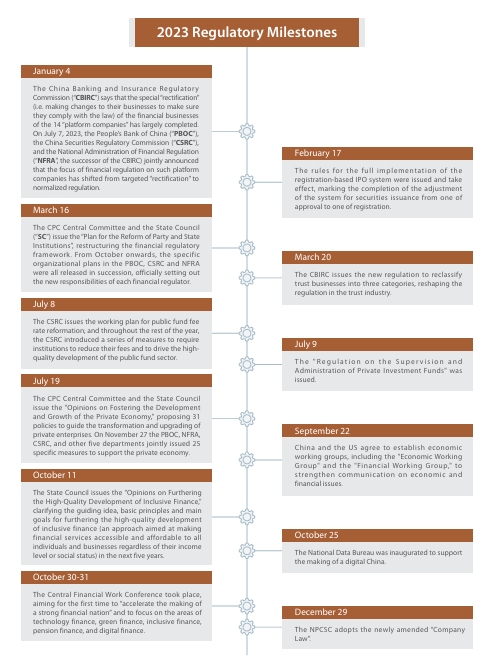
2023 Regulatory Mainline Review
01 The Financial Sector Receives Strategic
Repositioning, with Top-level Direction
In 2023, China’s financial services sector was accorded a
new strategic importance. While previously the financial sector had
been categorized as an “important national core
competence”, now 2023’s Central Financial Work Conference
positioned finance as “the lifeblood of the national
economy” and, for the first time, proposed the goal of
building a “strong financial nation”, alongside other
“strong nations” (for example, culture, manufacturing,
and maritime activities).
At the same time, the systems and mechanisms regarding how the
Party will manage the financial work were targeted for improvement.
The “Plan for the Reform of Party and State Institutions”
established the Central Financial Committee and set up the Office
of the Central Financial Committee. The Plan also institutionalized
the top-level role of the CPC to design, supervise and implement
financial work, as well as having the power to review and make
decisions about major policies and issues in the financial
area.
The Central Financial Work Conference (held on October 30,
2023), unlike the previous five National Financial Work
Conferences, was attended by all Members of the Standing Committee
of the Political Bureau of the CPC Central Committee – the
highest leadership in China – and was named the Central
Financial Work Conference, indicating the unprecedented importance
that the Central Party has attached to China’s financial
services sector. In the next stage, while maintaining the existing
structure of specific financial regulators (which operate under the
State Council), the Party is expected to bring new ideas and
approaches to financial work through its centralized
leadership.
02 Restructuring the Financial Regulatory
Framework
Following the merger of the China Banking Regulatory Committee
and China Insurance Regulatory Committee into CBIRC in 2018,
China’s financial regulatory framework underwent further
restructuring in 2023. The intention is to optimize the system of
financial regulation and to build a strong nation.
In addition to adhering to the core design of the Central
Party’s unified leadership over financial work, the
establishment of the NFRA and the redivision of regulatory
functions with the PBOC and the CSRC mark the adjustment of
China’s regulatory framework to a kind of “twin
peaks” model. This model aims to promote market behavior
regulation, prevent speculative behavior, and protect consumer
rights, as well as to prevent risks and maintain financial
stability. Following the changes to the institutional structure,
the responsibilities between the regulators have been divided up as
follows: the PBOC is mainly responsible for formulating and
implementing monetary policy and macroprudential regulation; the
NFRA is mainly responsible for micro-prudential regulation and
consumer rights protection; and the CSRC is mainly responsible for
capital markets regulation. The NFRA is also expanded with a role
as the default regulator of all financial activities, especially
illegal financial activities. At the same time, the NFRA also has
the function of conducting microprudential regulation of banking
and insurance sector businesses. The role of the PBOC has become
clearer as a pure monetary authority.
The relationship between the central and the local authorities
has also been redefined. The starting point that financial
regulation essentially derives from a central authority has been
re-emphasized. That means having a central financial management
department with local branches. At the same time, local Party
committees will establish their own financial committees and
financial work committees to make sure that the financial work
instructed by the Central Party is carried out. The local financial
offices and financial bureaus in the local provincial government is
removed the responsibility/task for financial development that was
originally entitled to them.
These changes have helped to resolve functional conflicts
between the central organizations and local bureaus, as well as
clarifying rights and responsibilities. It is expected that with
the subsequent implementation of the “Regulations on Local
Financial Supervision and Management,” local financial
regulatory institutions will play a more active and effective role
in local financial risk prevention and resolution, as well as the
supervision of the “7+4” institutions, which mainly
refers to non-mainstream financial organizations that are mainly
local and professional companies, such as micro-credit company,
financing guarantees company, and various types of local trading
places.
03 New Requirements for “Political and
People-Oriented” Nature of Financial Work
The Central Financial Work Conference of October 2023 reiterated
the need for China’s financial sector to understand the
“political and people-oriented nature of financial work”,
by which it was meant that financial institutions should work in
people’s best interests. The Conference also called for the
financial sector to operate to the highest standards.
In 2023, many policies were set out directly targeted at
“common prosperity” and finance for the people: changes
were made to how much investors are charged (“public fund
fees”) to “enhance investors’ sense of gain”;
the State Council issued the “Opinions on Promoting
High-Quality Development of Inclusive Finance” in October
2023, clarifying the guiding principles and main goals for
promoting high-quality development of “inclusive finance”
in the next five years; the concepts of “new citizen
economy” and “silver-haired economy” (which refers
to the economics of serving older people) were introduced, and many
policies were introduced in areas such as pensions, family trusts,
and family wealth management, all with the aim of making sure that
people benefited from financial products and services.
All in all, there has been a real shift in the focus of the
financial sector. As indicated by the Central Financial Work
Conference, finance should provide high-quality services for
economic and social development. Policies and systems related to
currency, exchange rates, and capital markets should serve the real
economy (rather than simply being products that only benefit
financial institutions themselves).
There has also been much discussion about the professional
culture of financial institutions. In February 2023, an article by
the Central Commission for Discipline Inspection criticized the
“financial elite theory,” and the Central Financial Work
Conference emphasized the need to promote traditional Chinese
culture in the financial system, being honest and trustworthy, and
for all financial practitioners to be conscious of the need to be
aware of their legal responsibilities.
04 Greater Emphasis on Financial Services Supporting the
Real Economy
The Central Financial Work Conference defined unequivocally the
financial sector as “the lifeblood of the national
economy.” Subsequent financial policies in 2023 adhered to
this requirement. For example, the new rating method for the trust
sector included the ability of trust companies to serve the real
economy when it comes to assessing systemic risk, and the
“Regulations on Capital Management of Commercial Banks”
emphasized the new regulation’s orientation towards better
serving the real economy beyond pure capital regulation and risk
management. In the money markets, in addition to various
stimulative measures such as interest rate and fee reductions, the
government paid more attention to the phenomenon of “capital
idling” (which means funds circulating within the financial
sector without entering the real economy) in 2023 and expected to
invigorate such idle capital to supporting the real economy, as
opposed to the “virtual economy”. One bank was fined
RMB225 million during the year for carrying out activities that did
not serve the real economy, and that was the largest fine imposed
in the banking sector in 2023.
What is meant by “serving the real economy”? The
Central Financial Work Conference specifically defined the
“five major articles” as being “technology finance,
green finance, inclusive finance, pension finance, and digital
finance,” and explicitly required “allocating more
financial resources to promote technological innovation, advanced
manufacturing, green development, and small and micro enterprises,
vigorously supporting the implementation of the innovation-driven
development strategy, the regional coordinated development
strategy, and ensuring national food and energy security.” The
Central Economic Work Conference specifically proposed
“guiding financial institutions to increase support for
technological innovation, green transformation, inclusive small and
micro, and the digital economy.”
Of the “five major articles,” the one that received
most attention is technology finance. In the various enumerations
of the real economy field, “technological innovation,
‘specialized, fine, peculiar, and new'” high-end
manufacturing enterprises are given absolute priority. In the area
of capital markets, technological enterprises should be given
priority under what is called the “traffic light”
industry orientation, giving technology entrepreneurial enterprises
a high “political position”. The Beijing Stock Exchange
also continued to introduce various supportive policies to make it
easier for specialist enterprises to secure finance.
05 Progress in Risk Resolution and Normalization of
Disposal for Financial Institutions
Significant breakthroughs were made in the resolution of major
financial risks in 2023. The disposal of the last batch of
“Tomorrow Group” institutions was concluded, with four
insurance companies being restructured and Xinhua Trust ending in
bankruptcy liquidation; Huarong Asset changed ownership, with the
complete withdrawal of its financial subsidiaries; and risk
disposals of Evergrande Life Insurance, Sichuan Trust, some village
and town banks in Henan and Anhui, and related risks of Zhongzhi
Group proceeded steadily. As mentioned in our reports in the
previous two years, there has been a steady disposal of high-risk
financial institutions, which should mean that in future there will
be greater “normalization” in the financial sector. It is
worth noting that with the accumulation of regulatory experience,
effective coordination between central and local authorities, and
changes in resourcing, high-risk financial institutions should
present less of a problem in future.
“Stability before speed” has become the common feature
of disposals: in-depth investigations and sorting out of underlying
assets and liabilities in the early stage; long-term weighing of
schemes to maximize the gathering of risk-disposing resources and
balance the interests of all parties; and then rapid execution once
the scheme is determined to quickly resolve the crisis. For
example, the formulation of asset clearance and risk disposal
schemes for the Tomorrow Group institutions taken over in 2023 took
years, but once initiated, they were implemented swiftly and
decisively.
A second notable trend has been the transition from
administrative coordination to letting the market determine
outcomes. In the early cases of bailing out institutions such as
Baoshang bank, Anbang insurance, and Hengfeng bank, that involved
large-scale use of industry protection funds or funding from the
central government. More recently, there has been limited
administrative intervention, meaning that financial regulatory
authorities and judicial organs focus more on their statutory
responsibilities (rather than support more funds) and local
governments fulfill their local and stability maintenance
responsibilities – each performing their roles according to the
principle of “stabilizing the overall situation and
coordinating.” There are more market participants, for example
the involvement of investment funds from the insurance industry
being used when it came to the disposal of Huaxia Life and Huarong
Asset. At the beginning of 2024, the NFRA summarized in its work
conference the need to implement the “six-party
responsibility” of institutions, shareholders, senior
management, regulators, localities, and the industry, which is all
in line with the draft of the Financial Stability Law.
06 Restructuring Regulatory Model for Greater Science
and Rigor
The restructuring of the financial regulatory system has always
been an important part of financial reforms. China’s
traditional financial regulatory system is institution-based
regulation for different institutions. The National Financial Work
Conference in 2017 emphasized the function-based regulation and the
behavior-based regulation. The Central Financial Work Conference in
2023 further enriched the traditional financial regulatory system
into “institution-based regulation, behavior-based regulation,
function-based regulation, look-through regulation, and continuous
regulation,” making the regulatory system more scientific and
prudent.
The merger of the CBRC and the CIRC and the unified enforcement
of the bond market in the past few years are examples of
function-based regulation and behavior-based regulation.
Look-through regulation and continuous regulation are covered by
on-site inspections and the disqualification of non-compliant
shareholders of small and medium-sized banking and insurance
institutions in the past few years.
The regulatory model have restructured as part of the process of
making regulation more scientific and rigorous. So, for example,
the NFRA has set up the Department of Large Banking, the Department
of Joint-Stock and Urban Commercial Banking, and the Department of
Rural Small and Medium-sized Banking to supervise different types
of commercial banks – in other words, covering
institutions-based regulation. The Department of Science and
Technology Supervision, the Department of Asset Management
Institutions Supervision and the Department of Institutional
Recovery and Disposal, also created by the NFRA, focus on
function-based regulation. The responsibilities of financial
consumer protection, previously the remit of the PBOC and the CSRC,
have also been transferred to the NFRA – in other words,
focusing on behavior-based regulation. The establishment of the
Department of Corporate Governance Supervision and the Department
of Institutional Recovery and Disposal is intended to strengthen
the governance of financial institutions and promote the
systematization of institutional exit and risk disposal, reflecting
the idea of continuous regulation in the whole cycle and process of
financial institution governance and its disposal. The principle of
“substance over form” is embodied in look-through
regulation and features strongly in specific regulatory rules
(e.g., the qualifications of shareholders of financial
institutions, verification of the underlying assets of asset
management products, and the supervision of connected transactions)
and regulatory measures (market access, off-site supervision, and
on-site inspection).
07 More realistic system reform and more precise
regulation
The process of reforming the financial sector continued unabated
in 2023, which involved putting in place changes and bedding down
the existing framework. This took many forms, whether it was the
NFRA unifying the regulatory rules, the introduction of high-level
new regulations in areas such as private funds and payment
institutions, or the revision of basic regulations for commercial
banks, securities companies, and trust companies, the focus was
always on integrating and sorting out existing regulations,
generally in line with market expectations.
While partly adjusting the registered capital subscription
system, the new Company Law introduced innovative company
governance systems, allowing for easier capital reductions, among
other measures, as well as ascribing main responsibility for
governance to boards of directors. The CSRC twice sought the
market’s opinions on proposed changes to the Measures on
Derivatives Trading Supervision and Management and removed some
provisions in the second draft that were ahead of market practice .
This also indicated a desire of government departments to take a
more realistic attitude to institutional reforms.
However, the regulatory authorities do continue to intervene in
certain circumstances. For example, regulators issued instructions
regarding product registration and business expansion in the public
fund sector. Following the establishment of the registration
process for IPOs, the CSRC controlled the number of IPOs approved
in the second half of 2023. In the capital markets, the CSRC also
issued guidance to stock exchanges to formulate new regulations on
algorithmic trading, margin financing and refinancing. In other
areas, such as financial risk disposal, and real estate and debt
risk mitigation, regulatory authorities emphasized that there
should be no one-size fits all approach to utilize measures that
work for that particular sector and indeed that particular
situation.
08 Financial Law Enforcement: Stronger Structures and
Strict Supervision
In 2023, China’s financial regulatory authorities made
improvements to the structures of regulatory institutions as well
as stepping up enforcement. The NFRA established an enforcement
task force as a directly affiliated law enforcement authority
responsible for the investigation and evidence collection.
In terms of legislation, the draft regulations for the
supervision and management of securities companies and private
equity funds have significantly increased the levels of penalties
and broadened the scope of law enforcement. There were more large
fines imposed in 2023: the banking regulators imposed penalties of
approximately RMB200 million for a total of 38 violations by a
large state-owned bank in February and approximately RMB 225
million for a total of 56 violations by a joint-stock bank in
November. The NFRA imposed penalties on 4,750 (person-times)
banking and insurance institutions and on 8,552
“responsible” persons (person-times), with penalties and
confiscation of illegal proceeds totaling RMB7.838 billion. all of
which represented a significant increase compared to 2022.
The CSRC also focused on combating serious violations such as
financial fraud, fund appropriation, illegal guarantees, market
manipulation, and insider trading, cracking down on securities and
futures illegal activities, as well as counterfeiting.
The penalties imposed on large fintech companies and more
broadly on those companies falling foul of the regulations have
become more stringent. This is a reflection of the attitude of
strict regulation and zero tolerance, as well as the result of the
strengthening of the regulatory capacity of each regulatory agency
and the continuous improvement of the ability to identify
violations of the law based on the abovementioned ideas of
continuous and look-through regulation.
2024 Regulatory Outlook
01 Stability while Progress Creating before Phasing Out
Old Dynamics
The Central Economic Work Conference, held in December 2023,
spoke of the need for “Stability while Progress”,
“Promoting Stability through Progress” and “Creating
before Phasing Out Old Dynamics” in 2024. We believe that
these will be the core themes of financial regulation in 2024.
“Stability” is a long-term guiding value of financial
policy. “Progress” is the main policy goal of the new
stage. Taken together, “Promoting Stability through
Progress” means using regulations to solve problems and
resolve “contradictions”, particularly in areas such as
risk disposal. The principle of “Creating before Phasing Out
Old Dynamics” is to do with creating new industries and
dynamics while phasing out old industries and dynamics.
We expect that the regulatory policies in 2024 will be more
moderate and steady, focusing on stabilizing expectations and
growth. Financial innovation and non-standard investments may be
permitted but only in a limited way, and efforts may be made to
avoid short-termizing of long-term goals, such as adjusting the
pace of certain long-term goals like “dual carbon goals”
and the transformation of financial institutions.
The Central Political Bureau Meeting on December 8, 2023,
mentioned the need to “enhance the consistency of the
direction of macro policies,” so we expect there to be more
consistent application of multiple financial policies.
02 Expect More Legislation and Greater
Enforcement
As we progress through 2024, the process of passing legislation
and implementing regulations will continue. These will include a
series of foundational regulations in the financial sector,
including the Financial Stability Law, the PBOC Law, the Commercial
Bank Law, the Insurance Law, the Banking Supervision and Management
Law, and the Securities Company Supervision and Management
Regulations. Further regulations for financial holding companies
are also expected to be introduced. The updated regulations either
fill in the gaps and expand regulatory scenarios or keep pace with
the market, including, we expect, an increase in penalties for
those who are in breach of regulations.
The so-called gray areas in regulation, which gave rise either
to uncertainty or regulatory “arbitrage” (which enabled
institutions to play off one regulator against another) have
largely been eliminated after the completion of central
institutional reforms and the full settlement of central and local
financial decentralization. The NFRA stated in December 2023 that
financial authorities will guard their respective regulatory areas,
not only regulating “licensed violations” but also
“unlicensed driving.” We understand that cross-border
financial activities will still be a focus of financial
regulation.
In terms of the law enforcement, after the adjustment of powers
and the establishment of the enforcement task force within the
NFRA, the NFRA will become the center of financial law enforcement.
It will lead the establishment of a mechanism for claiming
regulatory responsibility and a safety net mechanism, promoting the
clear assignment of regulatory responsibilities for
cross-departmental, cross-regional, new industries and products.
Where it is not possible to allocate responsibilities, the NFRA
will be responsible for assuming supervisory responsibilities.
03 The Next Stage of Financial Institution Risk
Disposal: Institutionalization and Marketization
In 2024, the financial sector will shoulder the heavy
responsibility of supporting local government debt and real estate
risk resolution. There will also a strong focus on helping the
financial sector’s risk management and disposal.
So far as legislation is concerned, there will be a Financial
Stability Law and legislation introduced to cover insurance funds.
That will provide a more professional and predictable working
framework for financial risk disposal. The newly established
Institution Recovery and Disposal Department of the NFRA (referred
to above) will be specifically responsible for formulating the risk
disposal system, standards, and procedures for high-risk
institutions. In addition, financial regulatory authorities will
monitor the financial sector for high-risk situations and be
proactive in dealing with those risks.
Getting down to practical measures, some provinces have been
formulating and implementing reform and risk resolution plans for
small and medium-sized banks, to be followed by plans to address
risk resolution in non-banking institutions. The Non-Banking
Supervision Department of the NFRA has stated that the priority is
to initiate disposals of high-risk non-banking institutions by the
end of 2024. The very significance is that China is abandoning the
idea of institutions being “too big to fail”, while
merely protecting the interests of small investors and depositors
to the extent permitted by market capacity. A good example of this
was the approach to risk resolution of the Zhongzhi Group –
since it has met the standard of bankruptcy, just let it be
bankrupt.
04 Financial Markets: Supply-Side Reform
The Central Financial Work Conference has set the financial
regulatory (supply-side) structural reform as the best means for
ensuring financial services support the real economy and bringing
about high-quality development. This in line with the top-level
design of China’s financial market development.
There will continue to be a strong focus on the large
state-owned financial institutions. These measures may include
encouraging state-owned asset groups to rationalize the structure
of financial institutions internally, including considering
granting financial holding licenses, and enabling capital to expand
appropriately in the financial sector. Building first-class
investment banks is sure to be discussed in 2024; some major
securities firms have already included this goal in their five-year
plans. The CSRC has previously stated its support for mergers and
acquisitions between securities companies, and there have been many
rumors and discussions in the market about which companies this is
likely to include. The NFRA is studying whether to raise the
threshold for institutional access and is likely to give priority
to, market entities that comply with the policy of “serving
the real economy”.
At the beginning of 2024, the new financial leadership team has
made it clear that they aim to “attract more foreign financial
institutions and long-term capital to develop and thrive in
China,” so it is expected that there will be breakthroughs in
the entry, efficiency and scope of foreign investment in the
financial sector in 2024. This will continue the trend started in
2023. Regulators approved the application by a number of US
financial institutions to have wholly-owned control of, or to set
up, financial institutions in China. And the “Swap
Connect” was officially launched in May. However, for various
reasons, including geopolitical factors, some foreign financial
institutions withdrew their applications to open in China, while
other applications proceeded slowly. However, it should be noted
that the CSRC has shortened the time it takes for foreign
securities companies and fund management companies to open in
Shanghai, Hainan, and other six free trade zones, from six months
to 120 days.
In the coming year, industrial institutions and small and
medium-sized financial institutions can expect to be subject to
strict enforcement – at least those who have fallen foul of
the law. Even with the official relaxation of the platform economy
at the beginning of the year and some support for the private
economy, the first “private financial holding” license
has yet to be issued, and internet finance is subject to regular
regulation, reflecting the regulatory authorities’ continued
cautious attitude towards private capital’s investment in the
financial sector. In addition, with the increasing importance of
financial institution governance, the governance of small and
medium-sized life insurance, reform of rural credit cooperatives,
and mergers and reorganizations of small and medium-sized banks are
in full swing. Although most of these institutions have
“rectified” their governance procedures (i.e. brough them
in line with updated regulations), the regulatory authorities still
require them to be passed and approved for risk prevention.
05 Aiming for Confidence and Consistency
In October 2023, the PBOC mentioned in the report on the
financial work at the sixth meeting of the Standing Committee of
the 14th NPC that more efforts should be made to expand domestic
demand, boost confidence and prevent risks; further measures should
be implemented to activate the capital markets and boost investor
confidence. In addition, the financial institutions forum jointly
held by the PBOC, the NFRA and the CSRC mentioned in November 2023
that it was necessary to address the problems currently faced by
the financial sector to up confidence and look to the long
term.
We expect that the financial policies in 2024 will be more
people-oriented, paying more attention to short-term problems
directly linked to investor interests and public confidence. We
expect financial regulations will be more in tune with supporting
the market. Finally, we expect there to be greater consistency
between financial policies.
Originally published April 2024
The content of this article is intended to provide a general
guide to the subject matter. Specialist advice should be sought
about your specific circumstances.
link