
Key Highlights
| Study Period | 2019 – 2032 |
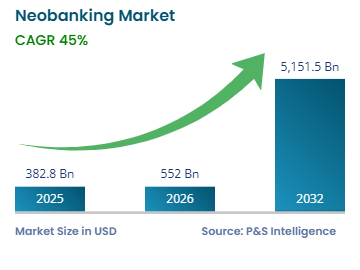
| Market Size in 2025 | USD 382.8 Billion |
| Market Size in 2026 | USD 552.0 Billion |
| Market Size by 2032 | USD 5151.5 Billion |
| Projected CAGR | 45% |
| Largest Region | Europe |
| Fastest Growing Region | Asia-Pacific |
| Market Structure | Fragmented |
Market Size
Explore the market potential with our data-driven report
Neobanking Market Future Outlook
The neobanking market size will be an estimated USD 382.8 billion for 2025, and it will grow by 45.0% during 2026–2032, to reach USD 5151.5 billion by 2032. The market’s rapid growth is driven by the rising global smartphone penetration worldwide, growing demand for seamless digital banking experiences, and the rising preference among millennials and Gen Z consumers for mobile-first financial services.
The ongoing digital transformation in the financial sector is accelerating the worldwide adoption of neobanking platforms. According to recent data, approximately 4.88 billion smartphone users worldwide represent a substantial addressable market for digital-only banking services. This widespread connectivity enables neobanks to offer instant account opening, real-time transaction processing, and personalized financial management tools without the constraints of traditional branch networks. Furthermore, the shift toward cashless economies and the integration of advanced technologies such as artificial intelligence and machine learning in banking operations are creating new opportunities for neobanks to differentiate themselves through innovative features and superior user experiences.
The competitive landscape has witnessed remarkable evolution as leading neobanks expand their service portfolios beyond basic banking to include investment products, cryptocurrency trading, and embedded finance solutions. This diversification strategy, combined with strategic partnerships with traditional financial institutions, is enabling neobanks to capture larger market share while addressing the comprehensive financial needs of both retail and business customers. As regulatory frameworks continue to evolve favorably in key markets, particularly in Europe with initiatives like PSD3 and open banking mandates, neobanks are well-positioned to capitalize on the growing demand for accessible, affordable, and technologically advanced banking services.
Neobanking Market Trends & Drivers
Growing Demand from Small and Medium Enterprises Is Key Trend
- The rising demand for SMEs represents a key trend for neobanking services, driven by these businesses’ need for efficient, cost-effective financial management solutions.
- In 2023, 70% of the SMEs reported using digital banking services for their business operations, highlighting the critical role of digital banking in modern business operations.
- SMEs particularly value neobanking platforms for their ability to streamline financial operations through integrated features such as automated accounting, real-time cash flow management, and seamless payment processing.
- The higher engagement rates among business customers reflect their reliance on digital banking for daily operations, from payroll management to supplier payments, making them particularly valuable clients for neobanks seeking to increase revenue per user.
- In India, 73% of MSMEs in semi-urban and rural areas have experienced business growth through the adoption of digital tools.
- Smartphones have become the dominant medium for managing business activities, and UPI is emerging as the preferred method for digital transactions.
- An OECD survey across seven countries indicates that SMEs are increasingly adopting digital tools to manage shocks and transitions, enhancing their long-term resilience.
Rising Smartphone Adoption and Digital Connectivity Are Biggest Drivers
- The proliferation of smartphones and enhanced digital connectivity represents a fundamental driver of neobanking market expansion.
- The proliferation of smartphones and internet access has accelerated digital banking adoption; 85% of Indian households now own a smartphone, and 86.3% have internet connectivity, enabling broader reach for neobanks.
- The technological infrastructure enables neobanks to reach previously underserved populations, particularly in emerging markets where traditional banking infrastructure remains limited.
- High digital adoption among SMEs and underserved markets is supported by improved connectivity and mobile-first banking, enabling seamless cash flow management, payroll processing, and supplier payments.
- The convenience of conducting financial transactions through mobile devices, from account opening to international money transfers, has fundamentally altered consumer expectations.
- Neobanks capitalize on this shift by offering intuitive mobile applications that provide comprehensive banking services accessible 24/7.
- This eliminates the need for physical branch visits and reduces operational costs that can be passed on to customers as lower fees or enhanced services.
- Ongoing technological innovation, fueled by fintech investment, positions neobanks to enhance mobile platforms and offer advanced, user-friendly digital banking solutions.
Neobanking Market Segmentation Analysis
Account Type Analysis
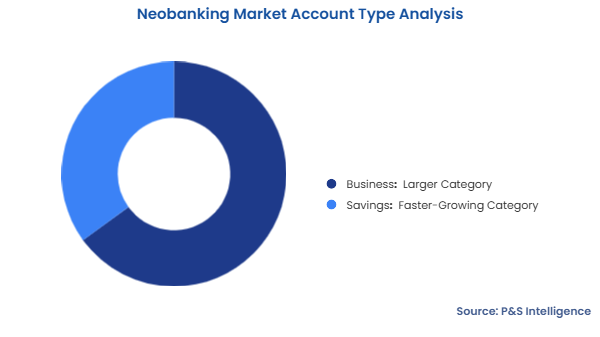
The business category holds the larger market share, of around 65%, in 2025, as enterprises increasingly adopt digital financial services to streamline operations and lower banking costs. Businesses are increasingly turning to neobanking platforms for their comprehensive suite of features tailored to commercial needs, including multi-user access, bulk payment processing, automated reconciliation, and integration with accounting software. The ability to manage complex financial workflows through a single digital platform has proven particularly attractive to SMEs and startups that require professional banking services without the high fees and lengthy processes associated with traditional business banking.
The savings category will have the higher CAGR, of 45.4%, due to the growing financial awareness among younger demographics and the innovative savings features offered by neobanks, such as automated savings rules, round-up mechanisms, and higher interest rates compared to traditional banks. The integration of gamification elements and goal-based savings tools has particularly resonated with millennial and Gen Z customers, who represent the largest user base for personal neobanking services. Additionally, partnerships between health technology companies and neobanks to offer specialized savings products, such as health savings accounts, are creating new growth avenues in this segment.
The account types analyzed in this report are:
- Business (Larger Category)
- Savings (Faster-Growing Category)
Service Type Analysis
The checking & savings account management category holds the largest market share, of around 40%, in 2025, reflecting the essential role of basic banking services in customer acquisition and retention strategies. Neobanks have revolutionized traditional account management by eliminating minimum balance requirements, offering free transactions, and providing real-time spending analytics that help users better understand and control their finances. The seamless user experience, combined with features like instant notifications, budgeting tools, and fee transparency, has made neobank checking and savings accounts increasingly attractive alternatives to traditional banking products.
The mobile banking category will have the highest CAGR, of 45.3%, driven by continuous improvements in mobile app functionality, user interface design, and the integration of advanced features such as biometric authentication, voice-activated banking, and AI-powered financial assistants. The shift toward mobile-first banking reflects changing consumer preferences, particularly among younger demographics who expect to manage all aspects of their financial lives through their smartphones.
As of 2024, global mobile money and mobile banking transactions reached approximately 108 billion in volume, with a total value of around USD 1.68 trillion. As per the GSM Association, this marks a year-on-year growth of about 20% in transaction volume and 16% in value. There are now over 2 billion registered mobile money accounts worldwide, with more than 500 million monthly active users, reflecting the rapid global adoption of mobile financial services.
The service types analyzed in this report are:
- Mobile Banking (Fastest-Growing Category)
- Payments & Money Transfers
- Checking & Savings Account Management (Largest Category)
- Loans & Credit
- Insurance & Investment
- Others
Application Analysis
The enterprises category holds the largest market share, of 55%, in 2025, driven by increasing smartphone adoption and the growing preference for digital-first banking experiences among individual consumers. The democratization of financial services through neobanking platforms has particularly benefited younger consumers and those previously underserved by traditional banks. Features such as no-fee international transactions, instant peer-to-peer payments, and integrated budgeting tools have made neobanks increasingly attractive for personal banking needs. The ability to open accounts instantly without visiting a physical branch has removed significant barriers to banking access, contributing to rapid user acquisition in this category.
The personal category will have the highest CAGR during the forecast period, due to the comprehensive financial management capabilities offered by neobanking platforms. Enterprise clients value neobanks for their ability to provide sophisticated treasury management, international payment solutions, and API-driven integration with existing business systems. Recent statistics reveal that 43% of SMEs have increased their use of online banking, while mobile banking usage has climbed by 40% in the past year. This trend reflects the growing recognition among businesses that digital banking solutions can significantly improve operational efficiency and reduce financial management costs.
The applications analyzed in this report are:
- Enterprises (Largest Category)
- Personal (Fastest-Growing Category)
- Others
Drive strategic growth with comprehensive market analysis
Neobanking Market Geographical Outlook
Europe Neobanking Market Size
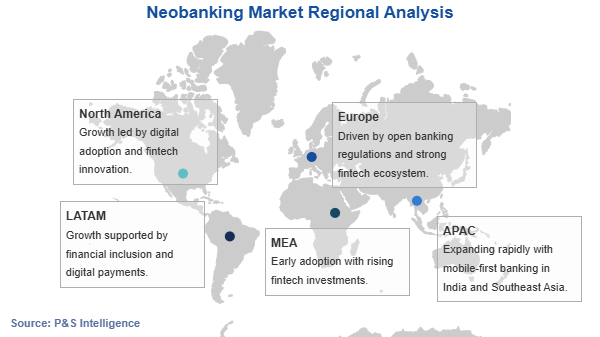
Europe holds the largest market share, of 35%, in 2025. This is primarily attributed to the region’s progressive regulatory framework, including initiatives such as PSD2 and the upcoming PSD3, which have created a favorable environment for digital banking innovation. The EU FinTech industry has grown significantly since the mid-2010s, with established players, such as Revolut, N26, and Starling Bank, achieving substantial market penetration across multiple European countries.
The European market’s maturity is further evidenced by the high adoption rates among both retail and business customers. European policymakers have taken proactive measures to support the fintech industry as they understand how important it is to the future of finance. The implementation of comprehensive regulatory frameworks, such as MiCA for crypto-assets and DORA, for operational resilience has provided clarity and stability for neobanks to scale their operations. Additionally, Financial institutions will have the ability to further digitize services and enhance customer experience, translating into faster account opening, easier on-sales, and cross-sales, driving continued growth in customer acquisition and engagement across the region.
The U.K. stands as Europe’s largest country market, supported by its role as a global fintech hub and the emergence of innovative challengers such as Monzo and Starling Bank, which have redefined digital banking standards. Meanwhile, Germany demonstrates the fastest growth rate among European countries, driven by its tech-savvy population and the success of homegrown neobanks like N26. The German market’s preference for digital solutions, combined with a strong economy and high smartphone penetration, has created ideal conditions for neobanking growth.
Asia-Pacific Neobanking Market Size
Asia-Pacific will have the highest CAGR, of 45.2%, driven by the region’s large unbanked and underbanked population, rapid smartphone adoption, and supportive regulatory environments in key markets. The combination of rising disposable incomes, increasing financial literacy, and government initiatives promoting financial inclusion creates a perfect storm for neobanking expansion in Asia-Pacific.
India, Indonesia, and the Philippines are witnessing rapid adoption of digital payment systems, which serve as a gateway for broader neobanking services. The success of regional players and the entry of global neobanks into these markets demonstrate the significant opportunities available. Furthermore, the region’s young demographic profile, with a high percentage of millennials and Gen Z consumers, aligns perfectly with the digital-first approach of neobanking platforms.
China represents the largest country market in Asia-Pacific, though its unique regulatory environment has created a distinct competitive landscape dominated by tech giants offering financial services.
India Neobanking Market Size
India has emerged as the fastest-growing market in the region, driven by the Unified Payments Interface (UPI), which has created a robust digital payments infrastructure. The rapid adoption of digital financial services in India, combined with a massive addressable market and increasing smartphone penetration, positions it as a key growth driver for the regional neobanking market.
In December 2024, UPI processed 16.73 billion transactions worth INR 23.25 lakh crore, up about 8% from November 2024. By March 2025, this rose to 18.3 billion transactions valued at INR 24.77 lakh crore. During the second half of 2024, total mobile payments in India reached around INR 198 lakh crore, with UPI alone contributing INR 130 lakh crore, reflecting a 30% year-on-year increase. Daily UPI transactions now exceed 590 million, highlighting India’s dominance in mobile-based digital payments.
The geographical breakdown of the market is as follows:
- North America
- U.S. (Larger Country)
- Canada (Faster-Growing Country)
- Europe (Largest Regional Market)
- Germany (Fastest-Growing Country)
- U.K. (Largest Country)
- France
- Italy
- Spain
- Rest of Europe
- Asia-Pacific (Fastest-Growing Regional Market)
- China (Largest Country)
- India (Fastest-Growing Country)
- Japan
- South Korea
- Australia
- Rest of APAC
- Latin America
- Brazil (Largest Country)
- Mexico (Fastest-Growing Country)
- Rest of LATAM
- Middle East and Africa
- Saudi Arabia
- South Africa (Largest Country)
- U.A.E. (Fastest-Growing Country)
- Rest of MEA
Neobanking Market Share Analysis
The market is fragmented with numerous players ranging from venture-backed startups to subsidiaries of traditional financial institutions competing for market share. This fragmentation is driven by the relatively low barriers to entry in terms of technology infrastructure, the availability of banking-as-a-service platforms, and the diverse regional regulatory environments that have enabled local players to establish strong positions in their home markets. Revolut, with its recent valuation exceeding USD 35 billion, and N26, valued at USD 6 billion, is setting the pace for market consolidation through aggressive expansion strategies and continuous product innovation.
It and other market leaders are leveraging their scale advantages to invest heavily in technology development, regulatory compliance, and marketing, making it increasingly challenging for smaller players to compete independently. The competitive dynamics are further intensified by traditional banks launching their own digital-only subsidiaries and big tech companies exploring financial services, adding new dimensions to the competitive landscape.
Key Neobanking Companies:
- Revolut Ltd
- Monzo Bank Limited
- N26 Bank SE
- Chime Finacial, Inc.
- Maybank Banking Berhad
- Starling Bank Limited
- Atom Bank plc
- Fi Brand Pvt. Ltd.
- Lili Banking, Inc.
- Varo Bank, N.A.
- Wise plc
- FamPay Pvt. Ltd.
Neobanking Market News & Updates
- In September 2025, ABN AMRO Bank N.V. chose the cloud banking platform of Mambu B.V. to drive BUUT, a new neobank project for customers aged 11 to 18 in the Netherlands. BUUT provides banking services tailored for teenagers, including Dutch IBAN accounts, debit cards, and a financial management system that divides funds into spending and saving categories.
- In September 2025, Plasma Inc. introduced Plasma One, a neobank fully centered on stablecoins. The aim is to facilitate a seamless experience for saving, spending, and earning in digital dollars. The platform aims to help stablecoin holders, who frequently encounter cumbersome interfaces, restricted local options, and difficulties when converting to cash.
- In September 2025, bunq B.V. introduced flexible cryptocurrency staking throughout the European Union without obligatory lock-up periods, in partnership with the crypto platform Kraken. These services enable users to earn up to 10% annually on specific cryptocurrencies. This service is available in the Netherlands, France, Spain, Belgium, Italy, Ireland, Germany, and the wider European Economic Area. Users can stake their digital assets to assist in validating blockchain transactions, while maintaining the flexibility to buy, sell, or withdraw their holdings at any moment.
- In September 2025, JSC TASKOMBANK initiated the development of a digital banking platform utilizing the Trigger Neobank Engine. The upcoming neobank will offer customers extensive financial management capabilities directly from their smartphones, such as remote account opening, instant digital card issuance, funds transfer, payment, deposit and loan application, and loyalty program access.
- In December 2023, Trigger Software Limited collaborated with Mambu to launch a comprehensive neobank engine designed to accelerate the development of digital banking platforms, providing core banking infrastructure for emerging neobanks.
- In October 2023, Starling Bank Limited expanded its banking-as-a-service offering, partnering with multiple fintech companies to provide white-label banking infrastructure, diversifying its revenue streams beyond direct-to-consumer services.
link