

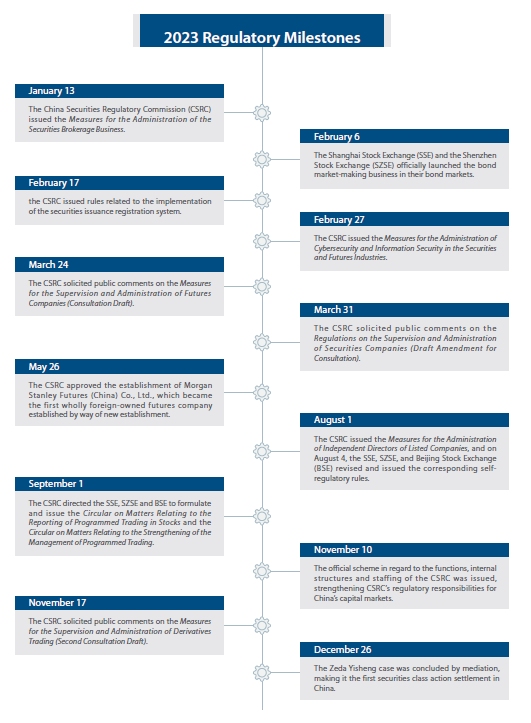
2023 Regulatory Mainline Review
01 Reform of the financial regulatory system, with a
clear signal to focus on the development of capital
markets
In March 2023, the Plan for the Reform of Party and State
Institutions was issued, proposing the establishment of the
National Financial Regulatory Administration (NFRA) based on the
former China Banking and Insurance Regulatory Commission (CBIRC),
which was responsible for the supervision of the financial services
sector, with the exception of the securities sector. The former
CBIRC was no longer retained, and the People’s Bank of
China’s daily regulatory responsibilities for financial holding
companies and other financial groups, financial consumer protection
responsibilities, and the investor protection responsibilities of
the CSRC were transferred to the NFRA. In addition, the CSRC was
restructured from being a public institution directly affiliated
with the State Council to becoming a government agency directly
under the State Council. Moreover, the responsibility for approval
of corporate bond issuance originally undertaken by the National
Development and Reform Commission (NDRC) was transferred to the
CSRC. Despite the replacement of the former CBIRC, the CSRC
retained its position and gained an upgraded status, reflecting the
importance attached to the regulation of securities and development
of the capital markets through top-level regulation.
02 Full implementation of the securities issuance
registration system, with corresponding improvements in the
supporting regulations
Following the success of the pilot system of registration in the
Sci-Tech Innovation Board, Growth Enterprise Market, and Beijing
Stock Exchange, on February 17, 2023, the CSRC issued rules for the
“comprehensive” implementation of the registration
system. Simultaneously, various securities exchanges, including the
National Equities Exchange and Quotations Co., Ltd., China
Securities Depository and Clearing Corporation Limited, China
Securities Industry Association, and other institutions, released
supporting implementation rules. This marks the expansion of the
system of registration to the entire market and all types of public
securities offerings (including stocks, convertible corporate bonds
and depositary receipts), representing a milestone in the
development of China’s capital markets.
Under the registration system, the issuance conditions under the
previous system (which was based on approvals) will be transformed
into disclosure requirements, as much as possible. Additionally,
the regulator and exchanges will monitor the quality of information
disclosure and enforce the chief responsibility of issuers for
information disclosure and the gatekeeper responsibility of
intermediary institutions through on-site supervision and
inspections. The division of responsibilities and operations for
exchanges review and CSRC registration have been unified and better
coordinated. The exchanges will conduct comprehensive reviews of
whether or not corporates meet the required issuance conditions,
listing conditions, and disclosure requirements, while the CSRC
will be tasked with ensuring compliance with national industrial
policies and sector positioning simultaneously and will carry out
registration procedures based on exchanges review opinions. The
full implementation of the new registration system will enable
corporates with development potential and excellent fundamentals to
be able to list more effectively and efficiently.
Following the implementation of the registration system, the
CSRC also improved the relevant rules. For example, on November 10,
the CSRC solicited public comments on the revision of the
Provisions on On-Site Inspection of Issuers for Initial Public
Offering and the Regulations on Supervision and Guidance
of Initial Public Offering and Listing of Stocks, aiming to
establish on-site inspection and listing guidance supervision
mechanism suitable for the registration system. Additionally, on
December 22, the CSRC revised and issued two financial information
disclosure rules to enhance the effectiveness of financial
information disclosure rules in the capital market. The
Optimization of relevant supporting regulations will further ensure
the smooth progress of registration system reform.
On April 10, 2023, the first batch of 10 companies was listed on
the Shanghai and Shenzhen Stock Exchanges’ main boards under
the new registration system, marking the comprehensive
implementation of stock issuance registration system. Around 290
companies were listed under the registration system in 2023,
accounting for over 90% of the total number of IPOs for the
year.
03 Revision and promulgation of multiple rules to
implement the Futures and Derivatives Law, and the futures
sector continues to open up
In 2022, the promulgation of the Futures and Derivatives
Law laid the overall regulatory framework for the futures and
derivatives markets. To implement this foundational law, in 2023,
multiple futures and derivatives related rules were introduced or
revised.
In March, the CSRC solicited public comments on the
Supervision and Administration of Derivative Trading and
the Supervision and Administration of Futures Companies.
Additionally, the revised Measures for the Administration of
Futures Exchanges were formally promulgated to reflect and
elaborate on the contents of the Futures and Derivatives
Law. It is worth mentioning that the Measures for the
Supervision and Management of Futures Companies (Consultation
Draft) underwent significant revisions, particularly expanding
the scope of futures companies’ business. Subject to certain
qualification requirements, futures companies are allowed to engage
in futures market making and derivatives trading, which were
originally within the business scope of risk management subsidiary
of the futures company. This should bring new opportunities for
leading futures companies to further expand and strengthen their
businesses.
In November, the CSRC solicited public comments on the revision
of the Measures for the Supervision and Management of
Derivative Trading (Second Consultation Draft). Compared to
the first draft published in March 2023, this second Consultation
draft adjusted the scope of derivatives trading institutions,
reports on derivatives contract development, and supervision of
overseas/cross-border derivatives transactions. However, for
certain issues that sparked market discussion, such as the
consolidation of positions of exchanges and OTC market and
prohibited trading activities, the CSRC maintained a strict
attitude consistent with the first draft, reflecting its cautious
approach to strengthening regulation in the derivatives market,
addressing regulatory gaps, and its determination to combat illegal
activities and prevent risks in the derivatives field.
In addition, the CSRC and the China Futures Association (CFA)
have also established and improved applicable rules regarding the
management of futures practitioners, the opening of accounts for
futures companies, and the management of futures market positions.
For example, the Interim Provisions on Futures Market Position
Management issued on July 31, 2023 stipulate regulations on
position limits and exemptions, hedging, reporting of large
positions, and position aggregation, filling the gap in position
management requirements at the departmental regulation level.
Further to rule revisions and updates, in 2023, various
securities and futures exchanges also introduced many new futures
and options products. For instance, in June, two exchange-listed
options contracts based on the Sci-Tech 50 Index – Huaxia
Sci-Tech 50 ETF Options and E Fund Sci-Tech 50 ETF Options –
were listed on the Shanghai Stock Exchange, with the combined scale
of the two ETF products exceeding RMB 87 billion. In July, lithium
carbonate futures and options were listed on the Guangzhou Futures
Exchange, becoming the second largest listed product after
industrial silicon futures and options.
Meanwhile, the opening-up of the futures sector continued. In
January and August 2023, a total of nine futures and options
contracts from the Zhengzhou Commodity Exchange and the Shanghai
International Energy Exchange were designated as specific domestic
products, allowing the participation of overseas traders in
trading. Additionally, on November 24, 2023, the Hong Kong
Securities and Futures Commission (SFC) and the Hong Kong Stock
Exchange (HKEx) simultaneously announced plans to launch treasury
futures contracts in Hong Kong, offering additional risk management
tools for overseas investors and generally enhancing the ecosystem
of offshore renminbi products.
04 Improvement of securities firms-related regulatory
rules, involving multiple business and internal control compliance
aspects
In 2023, the CSRC and the Securities Association of China (SAC)
issued and revised multiple regulatory rules related to securities
firms, covering supervision and administration of securities firms,
business rules, internal control compliance, and other aspects.
Specifically, on March 31, the CSRC solicited public comments on
the Regulations on the Supervision and Management of Securities
Firms (Revised Draft for Consultation) to further implement
the requirements of the new Securities Law enacted in 2019.
Adjustments or supplements were made in the corporate governance,
compliance risk control, and business rules of securities
firms.
At the level of business rules, the CSRC issued the Measures
for the Administration of Securities Brokerage Business in
January 2023, which clarified the scope of brokerage business,
optimized business processes, and strengthened client behavior
management and rights protection. The SAC subsequently released
related detailed business rules. In February, the CSRC put into
place corrective measures for illegal cross-border business by
domestic securities firms’ overseas subsidiaries, prohibiting
overseas institutions without domestic licenses from opening
accounts for new domestic investors and requiring them to resolve
existing domestic clients in an orderly manner. Regarding the bond
business, in July and October 2023, the SAC issued several rules,
involving underwriting, entrusted management, handling of bond
default risks, and quality evaluation of bond businesses. In
October 2023, the CSRC made adjustments to margin trading and the
Shanghai Stock Exchange and Shenzhen Stock Exchange issued notices
regarding margin trading and securities lending trading
arrangements. Securities firms were required to establish sound
mechanisms for margin trading securities sourcing, penetration
verification, and access control, and strengthen management of
margin trading transactions. Most securities firms had implemented
these requirements by the end of 2023.
In terms of internal control and compliance rules, the SAC
issued multiple related rules in 2023, such as the Guidelines
for Internal Auditing of Securities Firms, Guidelines for Stress
Testing of Securities Firms, Guidelines for Operational
Risk Management of Securities Firms, and norms related to
employees’ integrity and professional conduct. On November 3,
2023, the CSRC solicited public opinions on the Regulations on
Calculation Standards for Risk Control Indicators of Securities
Firms, whose aim was to improve the risk control indicator
calculation standards adopted by securities firms for market
making, asset management, participation in public real estate
investment trusts (REITs), while strengthening classified
supervision, supporting compliant and stable high-quality
securities firms to improve capital utilization and providing more
leverage space for leading securities firms.
05 Improvement of information technology-related rules
in the securities and futures sector, and introduction of
regulatory measures for algorithmic trading
In recent years, securities and futures companies have resorted
to using an increasing number of technological tools and. That has
led to a number of regulations and rules being introduced to cover
how these tools are used in securities and futures businesses in
2023.
In March 2023, the CSRC issued the Measures for the
Administration of Cybersecurity and Information Security in the
Securities and Futures Industries, which covers various
entities such as infrastructure operators, operating institutions,
and information technology system service providers in the
securities and futures field, proposing more comprehensive
regulatory requirements for cybersecurity, personal information
protection, and other issues. In June, applicable industry
associations issued a three-year improvement plan for the cyber and
information security of securities firms, futures companies, and
fund management companies, further refining the work objectives and
requirements of relevant institutions. Meanwhile, in April, the
CSRC solicited public comments on the Administrative Provisions
on Trading Server Colocation for the Securities and Futures Markets
(Consultation Draft), aiming to regulate the provision of
trading server colocation services by securities and futures
exchanges and the leasing of related colocation services by
securities and futures operating institutions. Furthermore, the
CSRC released a series of financial industry standards related to
information technology in the securities and futures industry in
2023, continuously improving the informatization construction of
the securities and futures field.
Another major regulatory measure that attracted market attention
in 2023 was the introduction of rules related to algorithmic
trading by the Shanghai, Shenzhen, and Beijing stock exchanges. On
September 1, 2023, the three exchanges simultaneously issued
notices regarding matters related to the reporting of algorithmic
trading in stocks and strengthened management of algorithmic
trading. Building upon the existing system for reporting
algorithmic trading in convertible bonds, the exchanges officially
established a reporting system for algorithmic trading in the stock
market and stipulated that the requirements for algorithmic trading
would also apply to funds and depositary receipt trading conducted
on the exchanges. In addition to specifying reporting requirements
for investors, the notices also emphasized strengthening monitoring
of abnormal and high-frequency trading and required securities
firms to fulfill their responsibilities in managing algorithmic
trading. The introduction of these exchange-related rules is
conducive to guiding the standardized development of algorithmic
trading, assisting regulatory authorities in clarifying the
situations of quantitative trading in the domestic market and lay
the groundwork for subsequent regulation or reform.
06 Rules for overseas listing of domestic enterprises
fall into place, unified implementation of filing
requirements
On February 17, 2023, the CSRC issued rules covering the
management of overseas listings, including the Trial Measures
for Administration of the Issuance and Overseas Listing of
Securities by Domestic Enterprises, and five supporting
guidelines. The rules and regulations refine the “negative
list” – situations where overseas issuance and listing are not
allowed according to the principle of “minimum and
necessary”, do not set additional thresholds and conditions
for overseas listings, as well as specifying the requirements of
the overseas listing filing process. Such measures bring together
in one place the filing management process for both direct and
indirect overseas listings by enterprises and also require overseas
securities firms acting as sponsors or lead underwriters for
domestic enterprises’ overseas issuance and listing businesses
to fulfill filing obligations to the CSRC. These changes to the
overseas listing regulatory system emphasize the combination of
delegation and regulation and are intended to make it more
efficient for domestic enterprises to secure overseas
financing.
On the same day, the CSRC signed a memorandum of regulatory
cooperation with the SFC on matters related to overseas listings,
clarifying the regulatory cooperation arrangements and procedures
in areas such as issuance and listing, cross-border law enforcement
cooperation, intermediary supervision, and information exchange.
This was intended to strengthen regulatory cooperation on matters
related to mainland Chinese enterprises listing in Hong Kong.
In addition, to provide clearer guidance for the confidentiality
and archive management of enterprise overseas listing activities
and improve related cross-border regulatory cooperation
arrangements, the CSRC, together with applicable departments,
revised and issued the Provisions on Strengthening the
Confidentiality and Archive Management of Domestic Enterprises’
Overseas Issuance of Securities and Listing on February
24.
As of December 31, 2023, 81 companies received notice that they
needed to file for overseas listing filings (including filings for
overseas issuance and listing and filings for “full
circulation” of unlisted shares domestically), while 87
enterprises were in the process of filing. Additionally, as of
December 31, 2023, 185 overseas securities firms engaged in
domestic enterprises’ overseas issuance and listing businesses
had completed their filings with the CSRC.
07 Major changes in regulations of bonds and multiple
institutional reforms including bond registration
In 2023, significant changes were made to China’s bond
regulatory system, and the regulators introduced many policies to
promote the development, unification and standardization of the
bond market. Based on the reform of the financial regulatory system
by the State Council, bond market regulation tended to be unified.
In addition to the supervision of the interbank bond market
retained by the People’s Bank of China, corporate bonds fell
under the supervision of the CSRC. The transition period for
corporate bonds was completed on October 20, 2023. On the same day,
the CSRC clarified the arrangements for accepting and reviewing
corporate bond registration, custody, risk prevention and control,
and issued revised rules related to the issuance and trading of
corporate bonds, incorporating corporate bonds into the regulatory
scope, and establishing a unified regulatory system for corporate
bond regulation rules.
Another significant change in the bond market in 2023 was the
refinement of the system of bond registration. On June 21, the CSRC
issued the Guiding Opinions on Deepening the Reform of the Bond
Registration System and the Guiding Opinions on Improving
the Practice Quality of Bond Business of Intermediary Institutions
under the Registration System. These were intended to optimize
the bond review and registration process, strengthen the management
of bonds during the issuance period, make clear the
responsibilities of issuers and intermediary institutions, and
improve the quality of intermediary institutions. At the same time,
efforts were made to increase the crackdown on serious violators of
laws and regulations in the bond market.
Furthermore, to promote the high-quality development of the bond
market and enhance market vitality, the Shanghai Stock Exchange and
Shenzhen Stock Exchange officially launched bond market-making
services on February 3, 2023. By the end of 2023, a total of 15
institutions had become market makers on the Shanghai Stock
Exchange’s bond market, with 14 of them also providing
market-making services for the Shenzhen Stock Exchange’s bond
market.
In addition to these changes, many new regulations targeting
specific enterprises or specific areas of bonds were introduced in
2023. In April, the CSRC issued the Action Plan for Promoting
the High-Quality Development of Bonds for Technology Innovation
Companies, making it easier for high-tech companies to access
the bond market; in December, the CSRC and the State-owned Assets
Supervision and Administration Commission (SASAC) jointly issued
the Notice on Supporting Central Enterprises to Issue Green
Bonds, with the aim of facilitating finance support for the
issuance of green bonds and to encourage central enterprises to
invest in green projects.
08 Strict crackdown on illegal activities in the
securities field and maintaining a high-pressure enforcement
posture
In 2023, the crackdown on illegal activities in the securities
field continued to maintain a high-pressure posture, and
significant progress was made in several cases of false statements,
fraudulent issuance, and related investor lawsuits and claims.
In 2023, the CSRC remained focused on the compliance of
securities firms’ investment banking business. On September 6,
the CSRC issued 13 fines in one go, taking regulatory steps against
6 securities firms and 13 executives for violations of laws and
regulations related to investment banking. On December 8, 2023, the
Ministry of Public Security, in conjunction with the CSRC, cracked
down on multiple major cases of insider trading and market
manipulation, arresting more than 50 people in cases involving more
than RMB9 billion.
Regarding major cases of false statements and fraudulent
issuance related to securities, on July 28, after the Zeda Yisheng
Securities false statement liability dispute officially became the
second special representative litigation case in China after the
Kangmei Pharmaceutical case, the case was settled through mediation
on December 26, with the China Securities Investor Service Center
representing 7,195 eligible investors receiving full compensation
of over 280 million yuan, making it the first case of collective
securities litigation and settlement in China, with demonstration
significance. On December 29, based on the administrative law
enforcement commitment system stipulated in the Securities Law, the
CSRC signed commitment recognition agreements with intermediary
institutions involved in illegal and irregular activities under the
Zijin Storage case, with four intermediary institutions fulfilling
commitments such as paying commitment fees and self-inspection and
rectification. Under such a system, if the parties involved make
corresponding commitments during the investigation, the CSRC can
suspend the investigation, and if the parties fulfill their
commitments, the CSRC can terminate the investigation. This system
ensured efficient and maximum protection of investor interests in
the Zijin Storage case, while ensuring that the parties involved
were duly punished, which is of great significance for quickly
restoring market order.
So far as cross-border law enforcement is concerned, the CSRC
held two law enforcement cooperation work meetings with the SFC in
2023, exchanging work priorities and progress in major case
handling, which helps further improve the cross-border law
enforcement cooperation mechanism between the two places.
2024 Regulatory Outlook
01 Continuing to expand the opening up of the securities
and futures market to international participants
China made some progress in opening up the securities and
futures markets in 2023. We expect that in 2024 China will continue
to open up its securities and futures markets.
In 2023, the CSRC approved the establishment of some
foreign-funded securities companies and foreign-funded futures
companies such as Standard Chartered Securities (China) Co., Ltd.
and Morgan Stanley Futures (China) Co., Ltd. There are a number of
foreign-funded securities or futures institutions in the process of
applying to set up in China, and it is expected that more
foreign-funded securities or futures institutions will get approval
to carry out business in China in 2024. In addition, China is also
continuing to put in place supporting measures to facilitate
foreign institutions to expand their business in China. Among these
measures are recognition of overseas financial professional
qualifications in the securities, futures and funds sectors, and
facilitating the employment of qualified professionals from abroad
in China.
So far as cross-border trading is concerned, it is expected that
the interconnection mechanism between Mainland and Hong Kong Stock
Markets (the “Interconnection
Mechanism“) will expand in 2024. In August 2023, the
CSRC and the SFC reached a consensus to accelerate the inclusion of
block trading (non-automated counter trading) in the
Interconnection Mechanism, and the supporting rules are expected to
formally come into effect in 2024. The intention is that the
inclusion of block trades in the Interconnection Mechanism will
make for greater trading convenience and help to promote the
capital markets in both markets. As at the end of 2023, China’s
futures market had 24 specific products open to foreign traders for
trading, and 46 commodities, stock index futures and options
products were open to QFIIs and RQFIIs for trading, of which the
proportion of primary products had reached 96% and 70&
respectively. It is expected that in 2024, the varieties of futures
open to foreign traders as well as the varieties of futures and
options products open to QFIIs and RQFIIs, will continue to expand,
thus attracting more foreign institutions to participate in the
pricing of China’s primary product futures, enhancing the
representativeness and influence of China’s futures prices, and
providing more accurate price signals for industrial
enterprises.
Meanwhile, the Provisions on the Administration of Domestic
Securities and Futures Investment Funds of Foreign Institutional
Investors (Consultation Draft) issued in November 2023
abolished the administrative approval requirements for QFII and
RQFII to register their funds with the State Administration of
Foreign Exchange (SAFE), and further simplified the exchange
administration requirements. The formal implementation of this
regulation should encourage foreign institutional investors to
carry out securities and futures investments in China.
So far as cross-border listing is concerned, in June 2023 one
official of the SFC delivered a keynote speech entitled
Reconnecting with the Mainland Market, in which, apart
from mentioning the aforementioned deepening of the Interconnection
Mechanism, the official mentioned that SFC would establish flexible
regulatory approaches to accommodate more mainland companies
listing in Hong Kong and thereby assist China’s economic
restructuring. At the same time one CSRC official also mentioned in
a media interview in the middle of 2023 that further practical
measures would be adopted to support the development of the Hong
Kong market and to co-ordinate the enhancement of the activity of
A-shares and Hong Kong stocks. He also called for the support of
dual listing of US-listed shares in Hong Kong. In recent years,
through new initiatives such as the different voting rights
structure, the return of US-listed Chinese companies, and the
listing measures for biotechnology companies, the Hong Kong
securities market has absorbed many mainland enterprises to list in
Hong Kong. It is expected that by 2024, the Mainland and Hong Kong
securities markets will have further close ties in cross-border
listing.
In addition, in order to attract more foreign investment as well
as international cooperation, we will need to look out for
regulatory adjustment allowing for integrated group operation and
cross-border data transfer while the risk is controllable, which
has given rise to concern among international investors.
02 Improving bond market rules and promoting the
functioning of the exchange bond market
The bond market has introduced a number of new rules and
deepened the reform regarding the bond registration system in 2023.
It is expected that the CSRC will introduce more measures to
stabilize expectations and confidence and stimulate bond market
activities in 2024, including strengthening the investment side
regulations of the bond market, giving permission to banking
institutions to participate fully in the trading of the exchange
bond market, further advancing the reform of the inquiry and
quotation system, and granting more access to international
participants of China’s bond market.
In addition, we expect that in 2024, the authorities will
further promote the exchange bond market to reduce the cost of
financing, smooth financing channels, optimize the financing
structure and other functions, and raise the standards of the bond
market to serve the real economy, so as to better serve the overall
situation of the smooth operation of the economy through the bond
market. In terms of specific bond categories, in regard of REITs,
it is expected to have new categories of REITs including consumer
infrastructure, to promote REITs market for high-quality expansion,
and to press ahead the supply of high-quality REITs projects. The
CSRC also revealed that it is studying the launch of REITs-related
index and ETF products, as well as promoting the interconnection of
the REITs market with the Hong Kong market. We await announcements
on this score in the coming year. The main focus of real estate,
urban investment related bond is expected to remain on risk
resolution, prevention and control, supporting the reasonable
financing needs of normally operating real estate enterprises while
focusing on the steady resolution of the risk of bond defaults by
large real estate enterprises and strengthening the monitoring and
early warning of urban investment bond risks. Finally, we should
expect emerging bond products including science and technology
innovation bonds and green bonds that will further develop and have
a positive effect on China’s economy.
03 Possible further changes in the securities sector and
the Matthew effect further intensified
On October 31, the Central Financial Work Conference called for
the creation of first-class investment banks and investment
institutions. The CSRC followed this up by calling for the top
securities firms in China to enhance themselves through business
innovation, group operation, mergers and acquisitions, etc., so as
to build first-class investment banks, to help support the real
economy and to act as the ballast for maintaining the financial
stability.
According to the SAC, there are currently 146 securities
companies in China. There is a lot of competition between
brokerages. The Matthew effect is also more pronounced. If the top
securities firms focus on business innovation, group operation and
mergers and acquisitions, they can better fulfill resource
allocation and further enhance the influence of China’s local
securities firms on the world stage. With the encouragement of
policies, it cannot be ruled out that China’s securities sector
will be changed in 2024.
04 Stabilizing market confidence and enhancing
investment attractiveness of listed companies
According to statistics, a total of 313 new companies were
listed on the A-share IPO market in 2023, down by more than a
quarter (26%) on 2022. More enterprises than 2022 withdrew their
application to list. It can be seen that the pace of IPOs in the
A-Share market is gradually slowing down, which could possibly be
related to the CSRC’s emphasis since the end of August 2023 on
strengthening counter-cyclical regulation, phased tightening of IPO
to ensure a good quality of company listing.
“Enhancing the investment attractiveness of listed
companies and promoting the stable development of the capital
market” is a constant theme that has been emphasized by the
regulators. In September 2023, the CSRC convened three symposiums
to analyze the situation of the capital markets, exchanging views
on how best to invigorate China’s capital markets and to boost
investor confidence, as well as on the hotspot issues that are of
concern to the market. According to an article in China
Securities Journal, the CSRC has been in the early stage of
brainstorming a number of initiatives around the invigoration of
the capital market, the next step will be continuing to study and
validate the policy initiatives have not yet been launched and to
sweeten market expectations. Combined with the recent speech of the
relevant official of the CSRC, it is expected that specific
initiatives to be issued may include the establishment and
improvement of the listing and financing of science and
technology-based enterprises, more bond issuances, green channel
for M&A and reorganization, the introduction of the capital
market reform action plan of the investment side to increase the
introduction of medium- and long-term funds, improving the listed
companies dividends binding mechanism, amending the rules of the
system of share repurchase to relax the relevant conditions for the
repurchase, the introduction of rules on the restructuring of the
directional convertible bond, improving the review mechanism for
the micro restructuring of listed companies, enriching the payment
and financing tools for restructuring, pushing forward the
construction of a valuation system with Chinese characteristics,
and reasonably grasping the pace of IPOs and refinancing.
We expect overall the CSRC and the stock exchanges to adopt a
prudent attitude towards new IPO projects to address the imbalance
between the supply and demand of the capital in the secondary
market, and, on this basis, accelerate the implementation of
relevant policy initiatives in order to boost investor confidence
and invigorate the capital markets.
05 Ongoing regulatory transformation, with focus on
regulatory responsibility and accountability
After the reform of the issuance registration system, it will
continue to be a strong focus on the transformation of all-round
supervision by the CSRC, including corporate supervision,
institutional supervision, inspection and punishment, and
scientific and technological supervision. Among them, in recent
years, particular emphasis has been placed on cracking down on
illegal activities in securities and futures market, strengthening
the implementation of regulatory responsibility and accountability,
and improving the regulatory system and mechanism for inspections
and penalties. It is expected that these issues will continue to be
an important topic in the regulatory transformation of the CSRC in
2024.
The relevant official of the CSRC said in a recent speech that
the CSRC will strengthen its collaboration with the public security
and judicial organs, continue to improve the capital market system
and mechanism to prevent and combat fraud, promote the
administrative, civil and criminal three-dimensional accountability
system, increase the financial counterfeiting, fraudulent issuance,
market manipulation and other violations, and penalize the
intermediary institutions who fail to perform their duties. It is
expected that in 2024, the CSRC will still adhere to the regulatory
idea of “treating the root of the problem with
seriousness” and crack down on violations in the securities
and futures market.
The content of this article is intended to provide a general guide to the subject matter. Specialist advice should be sought about your specific circumstances.
link